
Fairy
Notícias de CassinoGuias de Jogos

Guia de Jogos de Cassino: Regras e Estratégias

Aprenda como jogar slots, blackjack, roleta e mais no Brasil. Regras, estratégias básicas e dicas para jogadores iniciantes. Pagamento via PIX.

Hop Review: Golden Eggs, Connected Wins and a 60,000x Ceiling
Hop
Hop Review: Golden Eggs, Connected Wins and a 60,000x Ceiling

Hop puts its premise on screen before the first paid action: The same listing dates the release to 2 April 2026, but its playable client stopped behind a verification page during this review. The visible theme gives the review a place to start, but it cannot fill gaps in the rule sheet. A public Venture Studios game listing describes Hop as a 5 by 3 high-volatility title with Connected Wins, a 96 percent return, a 4 percent edge and a maximum award of 60000 times stake; it also names golden-egg Scatters, free spins, a Super Wild multiplier wheel and feature-purchase modes. Exact values from the active operator build take priority wherever public records are absent, contradictory or inaccessible. The three horizontal pictures are editorial reconstructions based on the public mechanism list. They are not Venture Studios screenshots, and the illustrated symbol positions are not a recorded win.

This review uses a narrow evidence hierarchy. A first-party help panel in the deployed game would rank first, followed by a studio product page, then a public lobby record and finally a secondary catalogue. A picture may confirm visual identity, while a text listing may identify a grid or published return. Neither should be stretched into a claim about feature frequency, reel strips, random-number generation or the exact configuration used by a different operator. No paid wager was made for this article. The attempted public clients did not reach a usable game session, so there is no spin diary, hit-rate sample or personal balance result to report. The screen analysis instead asks what a Philippine player should verify once the local build opens: accepted stake, settlement unit, history entry, rule version, return setting, volatility label, maximum-award denominator and any separate cash limit. That is a more dependable review method than inventing a lucky session. The reconstructed pictures are designed to keep the discussion concrete on a phone-sized landscape canvas. Their controls, symbol positions, counters and values are props. They do not certify a pay route and must not be presented later as proof that a feature triggered. Where public material gives a specific layout, the artwork follows that broad structure; where the record is silent, the composition remains openly hypothetical. Every cash statement should still be checked against the accepted-round record after the screen has finished counting and before another action clears the display.
The First Hop Across the Garden

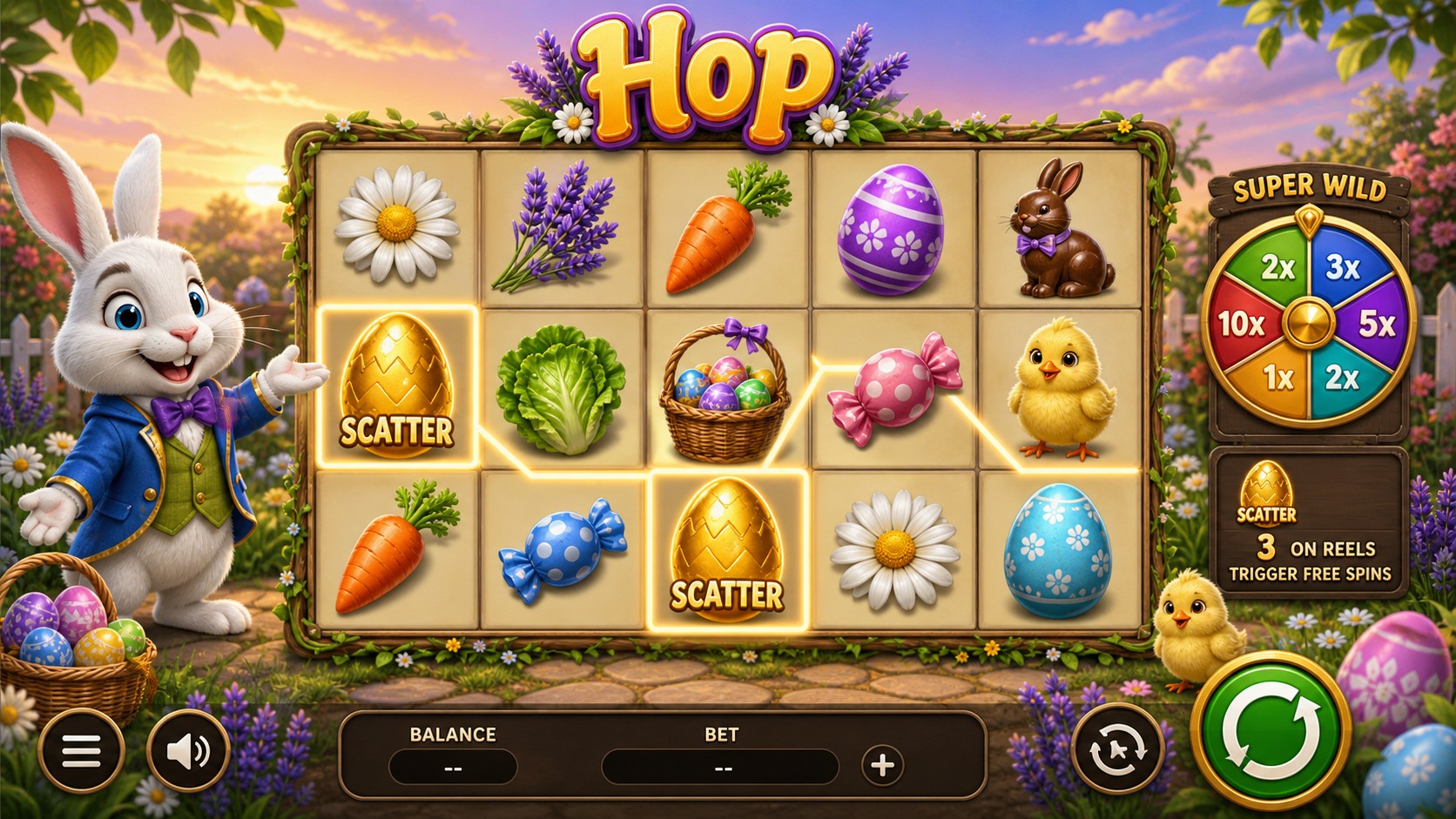
Hop opens with bright spring bustle. The white rabbit guide and carrots, lettuce, lavender, daisies, candy, painted eggs, chicks and chocolate rabbits are not background ornaments; they form a visual hierarchy that tells the eye where to look before any rule has been read. The reel area sits inside that hierarchy, so symbols remain distinct from the scenery instead of dissolving into it.

That first reading matters on a phone. A slot may spend heavily on illustration and still fail if the stake, spin control or settled result is hard to locate. Here the strongest idea is not mere decoration. It is the way sunrise peach, garden green, lavender purple and egg gold separates the game board, framing art and controls into layers.

What the Public Listing Confirms

A public Venture Studios game listing describes Hop as a 5 by 3 high-volatility title with Connected Wins, a 96 percent return, a 4 percent edge and a maximum award of 60000 times stake; it also names golden-egg Scatters, free spins, a Super Wild multiplier wheel and feature-purchase modes. The same listing dates the release to 2 April 2026, but its playable client stopped behind a verification page during this review. This is the firm boundary of the evidence used here.

A catalogue image can establish identity and art direction. It cannot establish the exact RTP setting, volatility band, reel mathematics, bet limits or highest award in every operator build. Those facts belong to the information panel of the version actually loaded.

Reading 96 Percent Beside a 4 Percent Edge

The public listing states a 96 percent return and a 4 percent house edge. Those figures are mathematical complements, which makes the listing internally consistent. They describe long turnover rather than a promise for a short garden session.

The same source labels volatility high and the maximum 60000 times stake. That combination points to a distribution with a remote upper tail, not to a frequent path toward the cap. The operator help page still controls if a regional configuration differs.

Why Hop Is Not the Pay Mechanism

The word Hop is the headline hook. It raises an obvious question: does it describe a multiplier, a progression, a visual motif or simply the scale of the story? Only the help screen can answer that. A number or power word in a logo is not automatically the highest cash ratio for a paid round.

Before treating the title as a promise, locate the line that defines it. Check the triggering symbols, the stage at which the value applies, any stake multiplier, the cap on simultaneous wins and any separate cash ceiling. If those conditions are absent, the name should remain a marketing label rather than a calculation.

The Published 5 by 3 Board

Hop is publicly described as a 5 by 3 game using Connected Wins. The grid is therefore more specific than a decorative preview, but the phrase still needs operational detail: matching symbols may need to begin on the first reel and touch across adjacent columns.

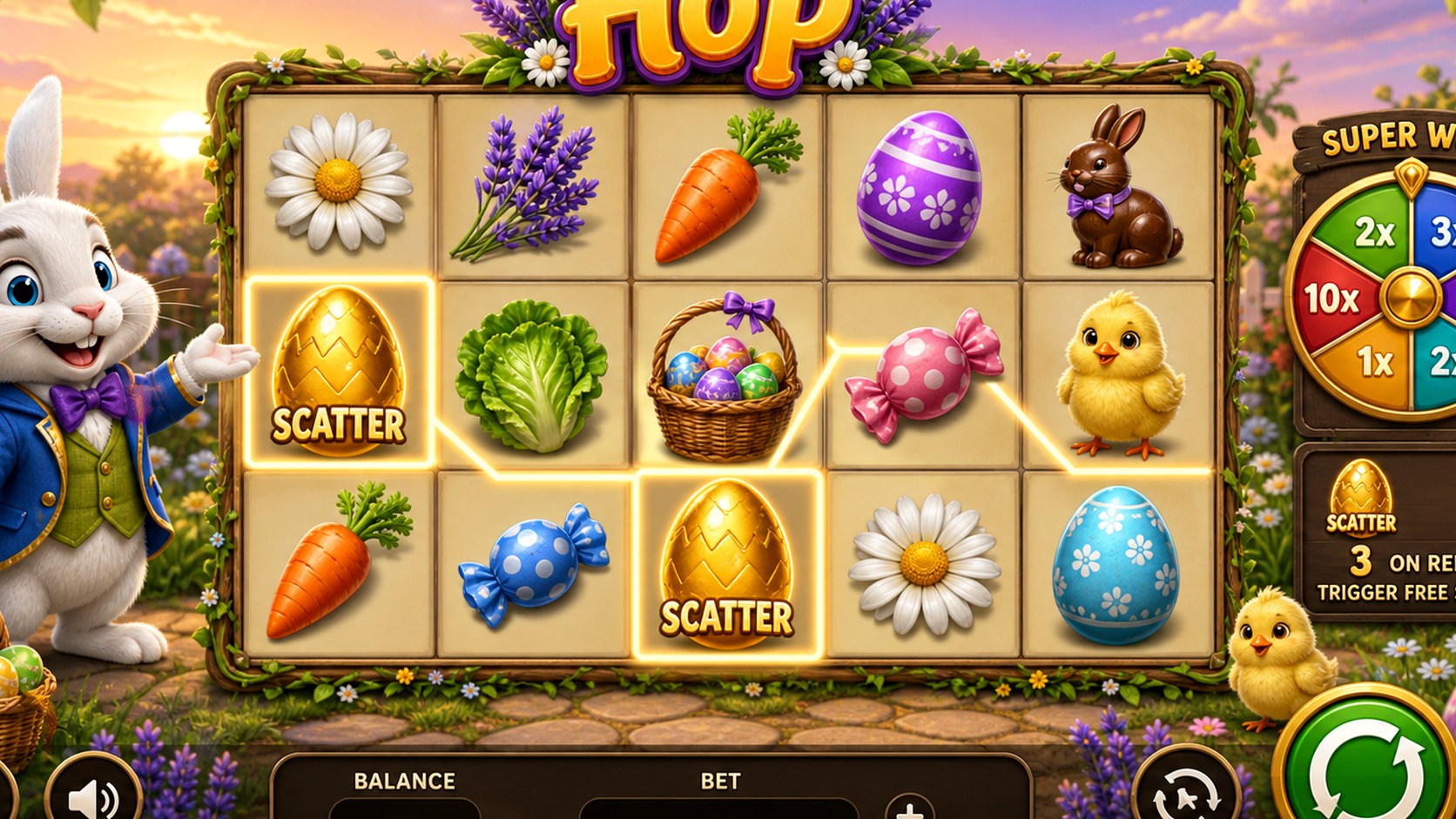
The editorial screen follows the published 5 by 3 geometry. Connected Wins still needs the active help page to define the starting reel, adjacency, minimum symbol count, overlap rules and any different behavior inside free spins.

Eggs, Plants, Candy and Characters

The theme naturally divides the reel set into character or object symbols, special icons and small garden and candy symbols. carrots, lettuce, lavender, daisies, candy, painted eggs, chicks and chocolate rabbits carry more visual weight than the letters and numbers. That weight usually signals premium status, but the paytable may rank two similar objects very differently. Size and shine are clues, never final values.

Read every payout in the unit used by the game. Some tables show bet-per-line units; others use total stake. A five-of-a-kind figure can appear ten or twenty times larger if the unit is misunderstood. The cash meter after a test spin is useful, but the written help panel should settle the conversion.

Quiet Symbols Inside Connected Wins

small garden and candy symbols occupy a large share of ordinary reel time in the editorial layout. They create visual breathing room around the premium art and make small combinations quick to recognize. Their role in the mathematical model may be larger than their small paytable values suggest because frequency and value are separate parts of return.

A low-symbol hit can light the grid while returning less than the amount staked. That is a paid result, not necessarily a profitable round. The correct comparison is final credit divided by the full spin cost. Animation length, coin count and sound volume do not change that ratio.

How Adjacent Matches Need to Connect

Large portraits and objects such as carrots, lettuce, lavender, daisies, candy, painted eggs, chicks and chocolate rabbits can dominate the frame. The practical test is to follow one settled combination from its first symbol to its last without relying on flashing borders. Clear spacing between reels, consistent icon silhouettes and a visible route make the result easier to audit.

If several awards arrive together, open the win breakdown or history panel. One total may contain multiple lines, an anywhere payment and a modifier. Treating the largest symbol on screen as the sole cause can produce a false reading of the rule, especially when a substitute or multiplier is also present.

The Super Wild Has More Than One Job

The named Super Wild is tied to a multiplier wheel. Three questions remain essential: which ordinary symbols it copies, where it can appear and what the selected value multiplies. Its wheel value could affect one connected group, one round or a feature total.

Check if the Super Wild remains, moves or resets between free spins. A Wild that persists has a different value path from one that disappears after settlement, even when both use the same rabbit or egg artwork.

Golden Eggs and Eligible Positions

Golden eggs are publicly named as Scatters and the route into free spins. The exact required count, eligible reels and direct Scatter pay should be confirmed in the help page because a promotional summary rarely prints every threshold.

Record all egg positions on a trigger. Connected Wins adjacency may not apply to Scatters, so do not assume that eggs must touch unless the rules explicitly join the two systems.

Reading the Multiplier Wheel

The Super Wild multiplier wheel is a random modifier, not a progress meter and not a forecast. Its visible sectors describe possible selections only after the trigger conditions have been met.

When the wheel stops, capture its value and the award scope before the board settles. Then compare the unmodified symbol value, selected multiplier and credited total in history.
Base Rounds Before the Golden Eggs

Many reviews rush past the paid reels and treat the bonus as the only meaningful part. That misses the money path. Base spins create nearly all turnover, settle small and medium awards, and decide how long a balance remains available. A rare feature cannot repair a stake level that is too high for the intended session.

Hop needs ordinary results that are readable at a glance. A clean board lets the user distinguish a no-win, a partial return and a profit without waiting for a long count-up. That clarity is especially important when the surrounding spring garden at sunrise is busy and the screen uses strong motion.

What Free Spins Change

Free spins remove a fresh debit for the awarded actions and can introduce the Super Wild wheel. The manual should state the starting count, retrigger rule, Wild persistence and any change to Connected Wins requirements.

Feature-purchase modes are separate paid entries. Their prices, starting states and listed return values should be read independently rather than treated as shortcuts to the same economics as a natural golden-egg trigger.

Attaching a Wheel Value to the Correct Award

A wheel multiplier needs a named base. If it applies to one Super Wild connection, only that component should be increased. If it applies to every win in the free spin, the history entry should show the whole-round product.

Several Wild values can add, multiply or remain separate by cluster. The top figure on the wheel cannot answer that question; only the combination rule can.

Putting 60000x in Context

Clients often label results with tiers such as big, mega or super. Those labels are commonly based on the ratio between win and current stake. They do not prove that the result reached the mathematical ceiling. The count-up may also stop at a cash cap even when the theoretical symbol total is higher.

To calculate a genuine ratio, divide the credited result by the total stake removed for the paid round. Include free follow-up actions inside that same round unless the rules state otherwise. This method turns a loud presentation into a comparable number and avoids confusing coins on screen with peso value.

Picture One: Spring Garden Reconstruction

The first picture interprets Hop as a spring garden around a 5 by 3 board. Rabbit, eggs, flowers and candy follow the public theme, while the exact artwork and controls are newly made for this review.

The picture belongs to the visual review only. It must never be used as a substitute for a paytable, probability statement or operator-specific stake range.

Picture Two: Connected Route Close-Up

The second picture magnifies the adjacent-symbol route across the five columns. The highlighted path is explanatory and does not document a round settled by Venture Studios.

Its job is to make phone layout, symbol hierarchy and control placement easier to discuss. The written rules remain the authority for every cash calculation.

Picture Three: Golden Eggs and Wheel

The third picture concentrates on golden-egg Scatters and the Super Wild wheel. Its multiplier sectors illustrate scope questions; only the client rules can say which values exist and what each one multiplies.

A live history panel should show more than any promotional still: original stake, component awards, modifiers and final credit. That record is the correct place to audit settlement.

Garden log 19: Sound Design and Perceived Pace

bright spring bustle can be strengthened through layered music, reel-stop cues and short feature stingers. Sound is useful when it marks a trigger or completed calculation. It becomes less useful when every partial return receives the same fanfare as a clear profit.

Try several rounds with audio lowered. If the board still communicates outcome, the interface is doing its job. If the result becomes ambiguous without a voice line or long count-up, the visual feedback needs more attention. Audio should confirm settlement, not replace the numbers.

Garden log 20: Landscape Play and Thumb Reach

A horizontal phone gives the spring garden at sunrise room on both sides of the reels. The central board remains large while settings, stake controls and spin can occupy the lower band. This arrangement works best when the largest button sits away from the minus and plus controls.

Before rapid play, rotate the device, enter full screen and check the total-stake field after one adjustment. Browser bars and system gestures can cover edge controls. A test spin at the minimum setting confirms that the hit boxes match the visible buttons and that no accidental Max Bet control sits beneath the thumb.

Garden log 21: Portrait Mode Is a Compromise

Portrait layout may scale the entire game down or reorganize controls beneath the grid. Tiny payline markers and condensed help text are the first casualties. The screen can remain playable, yet accurate rule reading becomes harder when the table requires repeated zooming or horizontal swipes.

Use portrait mode for quick navigation, not for the first rules check. Landscape is the better place to compare total stake, balance and win because all three can remain visible together. The relationship between those numbers matters more than keeping the device in one hand.

Garden log 22: Performance on Mid-Range Phones

The artwork uses multiple layers, large character cutouts and particle effects. On a mid-range handset, watch for delayed button response after a count-up, audio falling out of step with the reels or a stake change taking effect one round late. Those are interface problems, not signs of altered probability.

Close other heavy apps and use a stable connection during the first session. If the client reconnects, verify balance and the last completed round in history before spinning again. A frozen animation can recover after the server has already settled the result, so the account record takes priority over the last visible frame.

Garden log 23: Stake Controls Deserve More Attention Than the Mascot

The friendly rabbit and rapid connected highlights can make high-volatility stretches feel lighter than their balance effect. The most useful habit is to read total stake after every change and before the first rapid sequence. Bet per line, coin value and total bet may occupy separate fields, and altering one can multiply the final debit.

A planned session should be written in money, spins and time. Divide the session amount by the intended number of paid rounds to find a workable average stake. Free actions do not add a new debit unless the client states a purchase. This arithmetic is dull, but it controls exposure more reliably than any theme-based hunch.

Garden log 24: RTP Belongs to Turnover, Not a Short Run

Once the deployed RTP is known, interpret it as a long-run model ratio. If the help page lists 96 percent, theoretical cost is four units per hundred units of turnover. That sentence is an example of the calculation, not a claim that this version uses 96 percent.

Turnover equals total paid stake across accepted rounds. A hundred spins at one unit create one hundred units of turnover even if several free actions appear between them. A short session may finish far above or below the model ratio because random outcomes do not settle into a neat percentage on demand.

Garden log 25: Volatility Is About Distribution

Volatility describes how payout value is spread across outcomes. A higher band usually places more weight in less common large results; a lower band usually returns more of its value through smaller payments. The label does not state when a feature will arrive or how long a losing sequence can last.

Without an official band, infer nothing from bright spring bustle. A calm fruit village can use severe math, and a battlefield can use a mild distribution. After the label is found, use it to size stake and session length, not to forecast the next reel stop.

Garden log 26: Maximum Win Needs a Denominator

The published maximum is 60000 times stake. Read x as the denominator stated by the deployed client, normally total stake for the originating paid round, and check for a separate fixed cash cap.

A maximum ratio is a boundary, not an expectation. High volatility and a very high ceiling say nothing about when or if a short session will reach a large fraction of it.

Garden log 27: A Clean Demo Test in Thirty Paid Rounds

Use the minimum fixed stake and create one row for each paid round. Record starting balance, debit, base credit, feature credit, ending balance and any meter change. Keep free actions inside the row of the spin that triggered them. This format exposes the money flow without treating a tiny sample as statistical proof.

Thirty rounds are enough to learn button behavior, symbol settlement and feature messages. They are not enough to estimate RTP or trigger frequency. The purpose is mechanical literacy. Stop the test once each major control has been checked; more spins do not turn an informal sample into certification.

Garden log 28: How to Audit a Bonus From Start to Finish

Capture the trigger screen, starting counter, carried stake and opening multiplier. Then note each retrigger, held symbol, expanding reel or meter reset. At the end, compare the feature total with the history record and final balance. Every free action should trace back to one paid round.

If a purchase button exists, treat it as a separate bet mode. Record its price as the full stake for that round and read its RTP entry independently if the client lists one. A purchased feature may use the same animation while carrying a different cost structure.

Garden log 29: Common Misreads Around Hop

The first misread is assuming that Hop states the unconditional top award. The second is assigning premium status solely from symbol size. The third is treating a filling Super Wild multiplier wheel as proof that a feature is due. The fourth is calling every substitute a multiplier Wild without checking the rules.

The fifth is copying an RTP from an unrelated review. The sixth is counting free actions as fresh paid spins. The seventh is judging profit from the win banner instead of balance movement. Each mistake disappears when the player keeps the stake field, history panel and help page in the same audit.

Garden log 30: What Philippine Players Should Verify

A Philippine listing may use peso values, wallet credits or a converted coin display. Confirm the minimum and maximum total stake, not merely coin size. Check that the operator names Venture Studios as the studio, and compare the logo with the official key art before assuming that a similarly named title is the same product.

Also read local rules for feature purchases, autoplay, session reminders and cash limits. These controls belong to the operator build and jurisdiction. A screenshot from another market can explain layout, but it cannot establish the available stake range or certified return in a Philippine account.

Garden log 31: Who Gets the Most From This Theme

Readers who like dense spring symbols, adjacent-match systems and rare large-award ceilings backed by a clearly stated maximum ratio will find the presentation immediately legible. The theme also suits short review sessions because the visual hierarchy can be judged quickly. That does not make the mathematical profile suitable for every budget; the actual volatility and minimum total stake still control that decision.

Anyone who dislikes dense side art or loud event effects should test the sound and fast-play controls first. A strong theme can be a reason to open a demo, but it is not a reason to ignore the paytable. Interest in the artwork and comfort with the stake are separate choices.

Garden log 32: A Practical Decision Checklist

Before real play, confirm the exact title, studio, RTP, volatility, win method, Wild exceptions, Scatter route, feature trigger, multiplier scope, maximum-win denominator and cash cap. Then set a total session amount and a stopping time. If any critical rule remains hidden, keep the title in demo mode.

During play, watch balance rather than animation. After play, compare opening balance, deposits, withdrawals and ending balance with the history log. This checklist does not change random results. It changes how clearly the cost and settlement can be seen.

Garden log 33: Final Reading: Theme First, Math Before Money

Hop has the strongest published specification in this group. Its 5 by 3 Connected Wins board, golden eggs and Super Wild wheel create a coherent rule set, while the high-volatility label and 60000x cap call for careful stake sizing rather than optimism

Hop earns attention through bright spring bustle and a tightly coordinated sunrise peach, garden green, lavender purple and egg gold palette. The next step is not a larger stake; it is the local information screen. Confirm the deployed math, test the controls at minimum value and treat every visual promise as a question that the rules must answer.

Garden log 34: Separating Hit Rate From Profit Rate

A hit is any result the rules count as a payment. Profit requires the credited amount to exceed the full stake for that paid round. A title can register frequent small hits while the balance declines. Without an official hit-frequency figure, the only safe statement is that the two rates are not interchangeable.

For a demo log, mark return ratios below 1x, exactly 1x and above 1x in separate columns. This reveals how many recorded wins were partial returns. It still does not predict future play, but it gives a much clearer account of the sample than a simple count of flashing win messages.

Garden log 35: Near Misses Are Animation, Not Progress

A bonus icon stopping just outside a payline or a premium symbol passing during reel motion can feel meaningful. Unless the written rule stores that event, it has no carry-over value. The next accepted round is not improved because the previous animation looked close.

The same caution applies to two trigger symbols when three are required. They may create suspense, yet their payment and stored effect depend entirely on the table. Record what was credited, then clear the image from the decision about the next stake.

Garden log 36: Fast Play Changes Exposure Speed

Fast play shortens animation; it does not normally change the random model. Its financial effect comes from time. More paid rounds can fit into the same minute, so the balance may move faster even though the stake per round stays fixed.

Measure pace before enabling it. Ten ordinary rounds on standard speed and ten on fast speed reveal the difference in turnover per minute. If the faster rate breaks the planned session limit, lower the stake or return to standard timing rather than relying on attention alone.

Garden log 37: Autoplay Needs Stop Conditions

Where autoplay is available, set a round count and use any loss, win or single-award limits shown by the client. Read those fields carefully because some are cash values while others are stake multipliers. An empty field may mean no automatic stop for that condition.

Remain present during automated rounds. Network reconnection, a feature choice or a changed balance can pause the sequence. Autoplay is a convenience control, not a budget system, and it does not make a long sample more likely to follow the theoretical return.

Garden log 38: Responsible Play in Plain Numbers

Set a sum that can be lost without affecting bills, savings or debt payments. Do not borrow to play, do not chase a prior loss and do not treat a rare large result as income. Time reminders and deposit limits are useful because strong game art can blur the length of a session.

If play stops feeling optional, close the client and use the operator exclusion or limit tools. The clearest review of any slot ends with the same fact: outcomes are random, the house keeps a mathematical margin over long turnover and no visual pattern creates a reliable edge.
Por Fairy Editorial - 20 Aug 2026
Crystal Caverns Megaways Review: Expanding Wilds Beneath a Rising Multiplier
Caverna de Cristal Megaways
Crystal Caverns Megaways Review: Expanding Wilds Beneath a Rising Multiplier

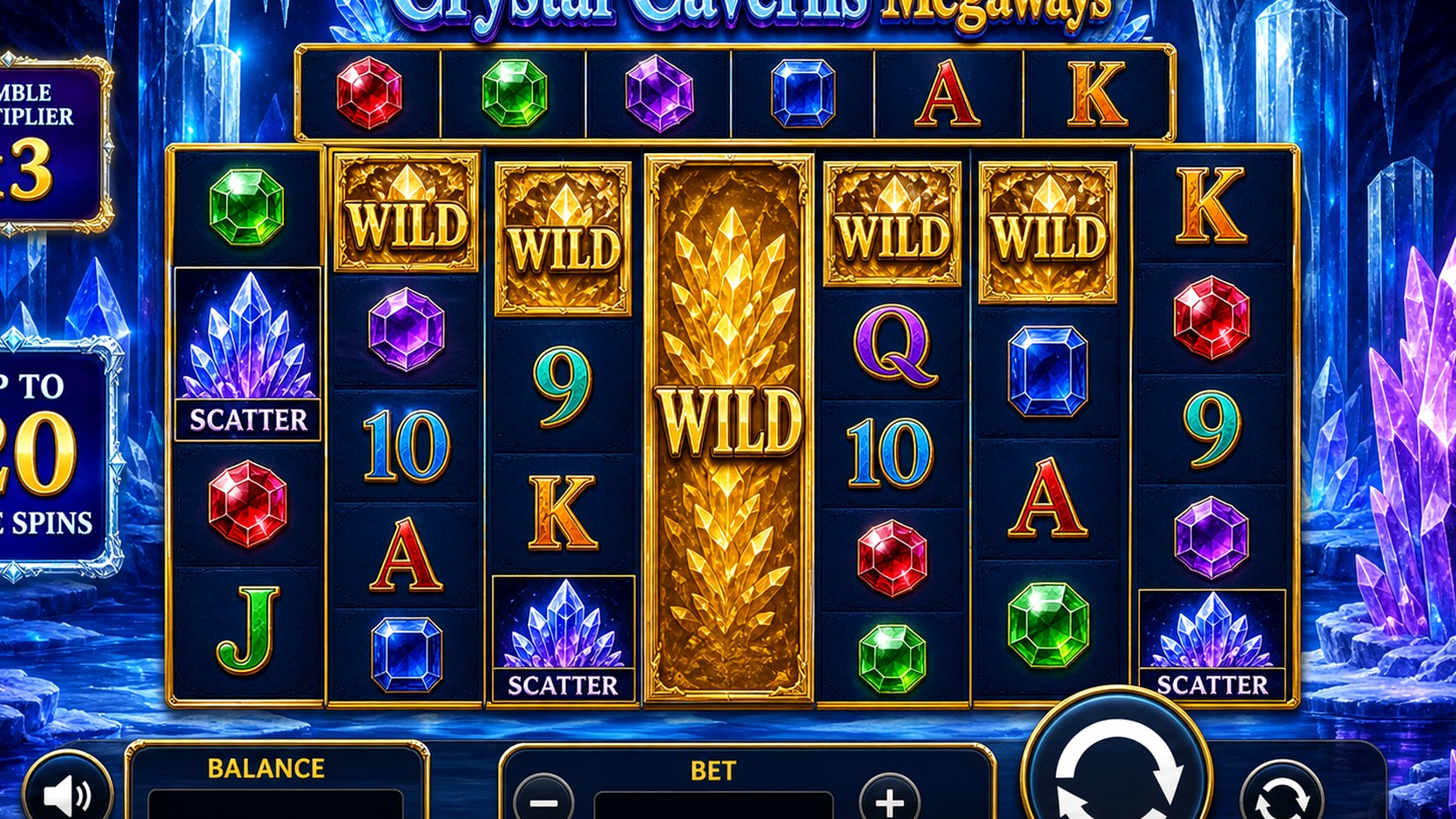
Crystal Caverns Megaways puts its central idea on screen before the first paid action. The user-supplied singular name refers to the same product, but the studio page uses Caverns in the plural. That gives the review a clear starting point without turning inaccessible details into guesses. Pragmatic Play identifies the official title as Crystal Caverns Megaways and describes a 6 by 7 Megaways grid, golden Wilds that expand when they land below the top row, Tumbles with an increasing multiplier, Scatter awards up to 100 times total bet and as many as twenty free spins. The operator help panel still takes priority for regional stake ranges, return variants and cash limits. All three horizontal pictures are editorial reconstructions based on Pragmatic Play public mechanics. They are not client captures, and the displayed Megaways geometry and multiplier are explanatory examples. This article follows a strict evidence order. A live help panel in the deployed client would rank first, followed by a studio product page, an operator listing and then a secondary directory. Artwork can establish identity and theme; it cannot certify reel strips, probabilities, feature frequency or a regional return setting. Any figure lacking a visible first-party rule is identified as secondary rather than repeated as fact. No paid wager was placed. The available demo components remained behind age or security layers, so there is no personal spin sample, balance result or claimed hit rate. The review instead maps each published mechanism to a check that can be completed once the Philippine build opens: stake debit, settlement unit, history entry, return configuration, volatility label, maximum-award denominator and cash ceiling. The reconstructed pictures keep the analysis concrete on a landscape phone canvas. Their controls, symbols, counters and values are props. They should never be reused as proof that a bonus triggered or a particular award occurred. Where the studio publishes a grid, the art follows its broad shape; where the record is silent, the layout is openly hypothetical.

The First Look Into the Ice

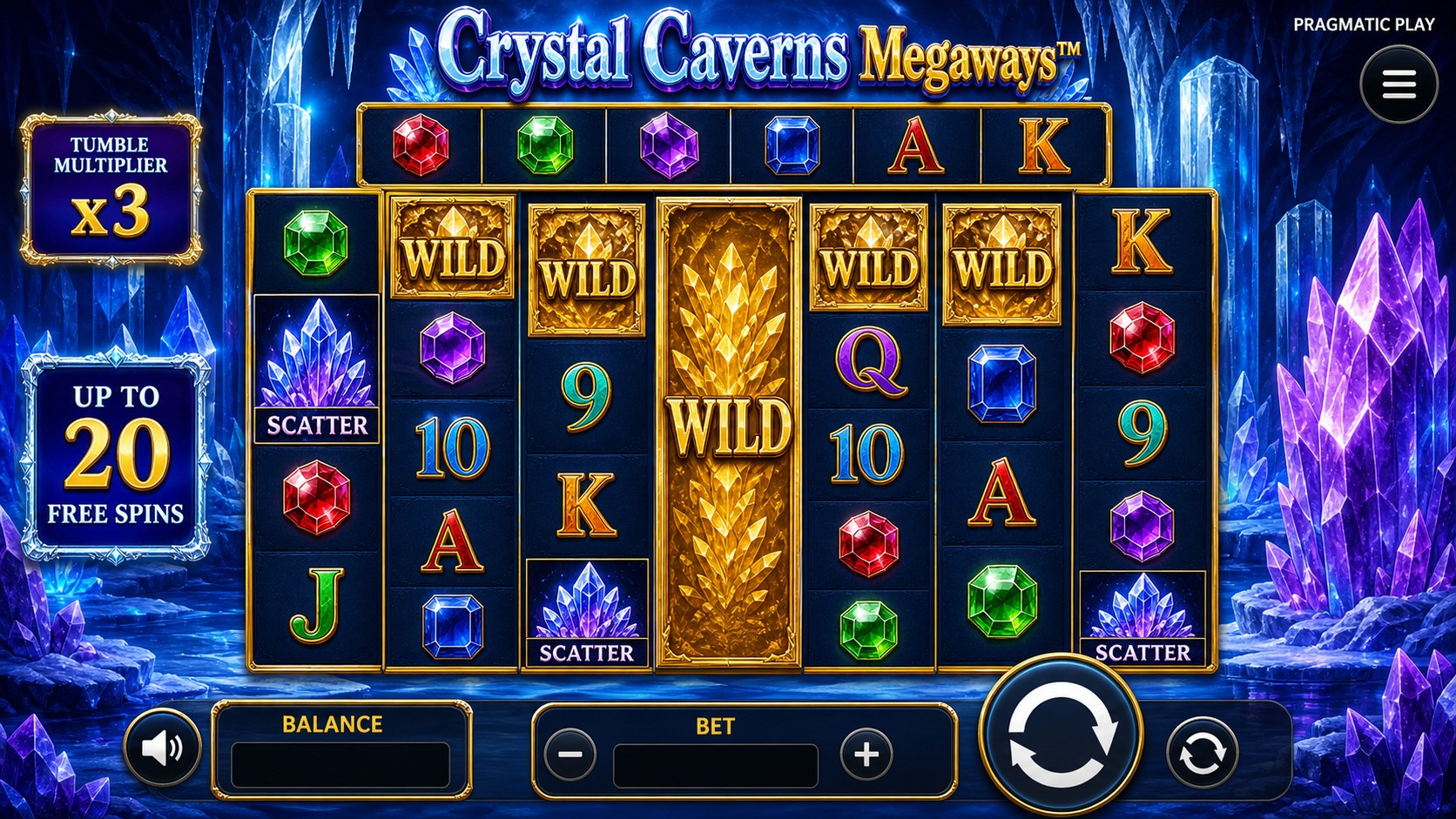
Crystal Caverns Megaways opens with cold mechanical escalation. The the changing reel array rather than a character mascot and rubies, emeralds, sapphires, amethysts, card ranks, golden Wild panels and crystal Scatters are not background ornaments; they form a visual hierarchy that tells the eye where to look before any rule has been read. The reel area sits inside that hierarchy, so symbols remain distinct from the scenery instead of dissolving into it.

That first reading matters on a phone. A slot may spend heavily on illustration and still fail if the stake, spin control or settled result is hard to locate. Here the strongest idea is not mere decoration. It is the way ice blue, violet crystal, emerald and reflective gold separates the game board, framing art and controls into layers.

What the Studio Page Confirms

Pragmatic Play identifies the official title as Crystal Caverns Megaways and describes a 6 by 7 Megaways grid, golden Wilds that expand when they land below the top row, Tumbles with an increasing multiplier, Scatter awards up to 100 times total bet and as many as twenty free spins. The user-supplied singular name refers to the same product, but the studio page uses Caverns in the plural. This is the firm boundary of the evidence used here.

A catalogue image can establish identity and art direction. It cannot establish the exact RTP setting, volatility band, reel mathematics, bet limits or highest award in every operator build. Those facts belong to the information panel of the version actually loaded.

The Secondary 96.46 Percent Listing

Independent catalogues repeatedly list a default return of 96.46 percent, while the public studio page used here focuses on mechanics rather than displaying that number in the accessible text. Treat 96.46 as a secondary listing until the local help screen agrees.

Pragmatic Play explicitly calls the game high volatility in its release notice. That label fits the tall variable grid and multiplier sequences but does not predict when a Tumble or free-spin trigger will occur.

Megaways Is a Counting Rule

The word Megaways is the headline hook. It raises an obvious question: does it describe a multiplier, a progression, a visual motif or simply the scale of the story? Only the help screen can answer that. A number or power word in a logo is not automatically the highest cash ratio for a paid round.

Before treating the title as a promise, locate the line that defines it. Check the triggering symbols, the stage at which the value applies, any stake multiplier, the cap on simultaneous wins and any separate cash ceiling. If those conditions are absent, the name should remain a marketing label rather than a calculation.

Six Reels With Changing Heights

The official description uses a 6 by 7 Megaways frame. Reel height can change, so the current number of ways must be calculated from visible positions across adjacent reels rather than assumed from one promotional maximum.

The artwork follows the published six-reel, up-to-seven-symbol Megaways structure with a top row. The exact number of ways changes from spin to spin and should be taken from the current counter, not assumed from the maximum shape.

Gems, Ranks and Golden Panels

The theme naturally divides the reel set into character or object symbols, special icons and jewel-edged card ranks. rubies, emeralds, sapphires, amethysts, card ranks, golden Wild panels and crystal Scatters carry more visual weight than the letters and numbers. That weight usually signals premium status, but the paytable may rank two similar objects very differently. Size and shine are clues, never final values.

Read every payout in the unit used by the game. Some tables show bet-per-line units; others use total stake. A five-of-a-kind figure can appear ten or twenty times larger if the unit is misunderstood. The cash meter after a test spin is useful, but the written help panel should settle the conversion.

Small Ranks in a Tall Grid

jewel-edged card ranks occupy a large share of ordinary reel time in the editorial layout. They create visual breathing room around the premium art and make small combinations quick to recognize. Their role in the mathematical model may be larger than their small paytable values suggest because frequency and value are separate parts of return.

A low-symbol hit can light the grid while returning less than the amount staked. That is a paid result, not necessarily a profitable round. The correct comparison is final credit divided by the full spin cost. Animation length, coin count and sound volume do not change that ratio.

How Adjacent Reels Form Ways

Large portraits and objects such as rubies, emeralds, sapphires, amethysts, card ranks, golden Wild panels and crystal Scatters can dominate the frame. The practical test is to follow one settled combination from its first symbol to its last without relying on flashing borders. Clear spacing between reels, consistent icon silhouettes and a visible route make the result easier to audit.

If several awards arrive together, open the win breakdown or history panel. One total may contain multiple lines, an anywhere payment and a modifier. Treating the largest symbol on screen as the sole cause can produce a false reading of the rule, especially when a substitute or multiplier is also present.

Where Golden Wilds May Expand

Golden Wilds appear away from the outer boundary described by the studio and can substitute for every symbol except Scatter. A Wild below the top row expands to cover the reel.

The manual should explain if the expansion occurs before ways are counted and if one expanded reel stays through the following Tumble. Timing controls how many later combinations can use it.

Crystal Scatters Have Two Roles

Crystal Scatters can pay up to 100 times total bet and can also award free spins. Those are separate cash and trigger roles, so history should show both when they occur together.

The maximum published free-spin count is twenty. The actual count depends on the number of Scatters and the table should list every threshold.

The Megaways Counter and Tumble Meter

The Megaways counter describes current geometry. The Tumble multiplier describes the current sequence. Neither carries into the next independent paid spin unless the rules state a feature exception.

Capture the starting multiplier, each Tumble increase and final reset. This prevents the last visible x value from being applied backward to earlier components.

Base Tumbles Before the Feature

Many reviews rush past the paid reels and treat the bonus as the only meaningful part. That misses the money path. Base spins create nearly all turnover, settle small and medium awards, and decide how long a balance remains available. A rare feature cannot repair a stake level that is too high for the intended session.

Crystal Caverns Megaways needs ordinary results that are readable at a glance. A clean board lets the user distinguish a no-win, a partial return and a profit without waiting for a long count-up. That clarity is especially important when the surrounding frozen crystal cavern is busy and the screen uses strong motion.

Up to Twenty Free Spins

Free spins retain the Tumble structure and use a multiplier that increases with each Tumble. The manual should state its starting value, increment and reset point, plus any retrigger path.

A twenty-spin award is the maximum starting or awarded count described publicly, not a guarantee attached to every Scatter trigger.

How the Rising Multiplier Is Applied

Pragmatic Play says the increasing multiplier applies to the total win from the Tumble. Audit the timing: the value beside the grid should match the component settled at that stage.

If several wins exist in one Tumble, confirm that they are summed before the multiplier rather than multiplied separately and rounded. History should show the same final credit either way.

A Secondary 10000x Claim Needs a Denominator

Clients often label results with tiers such as big, mega or super. Those labels are commonly based on the ratio between win and current stake. They do not prove that the result reached the mathematical ceiling. The count-up may also stop at a cash cap even when the theoretical symbol total is higher.

To calculate a genuine ratio, divide the credited result by the total stake removed for the paid round. Include free follow-up actions inside that same round unless the rules state otherwise. This method turns a loud presentation into a comparable number and avoids confusing coins on screen with peso value.

Picture One: Frozen Cavern Reconstruction

The first picture interprets the official ice-cavern theme around a variable-height array. It is original review art rather than a frame taken from the protected demo.

The picture belongs to the visual review only. It must never be used as a substitute for a paytable, probability statement or operator-specific stake range.

Picture Two: Variable Reel Geometry

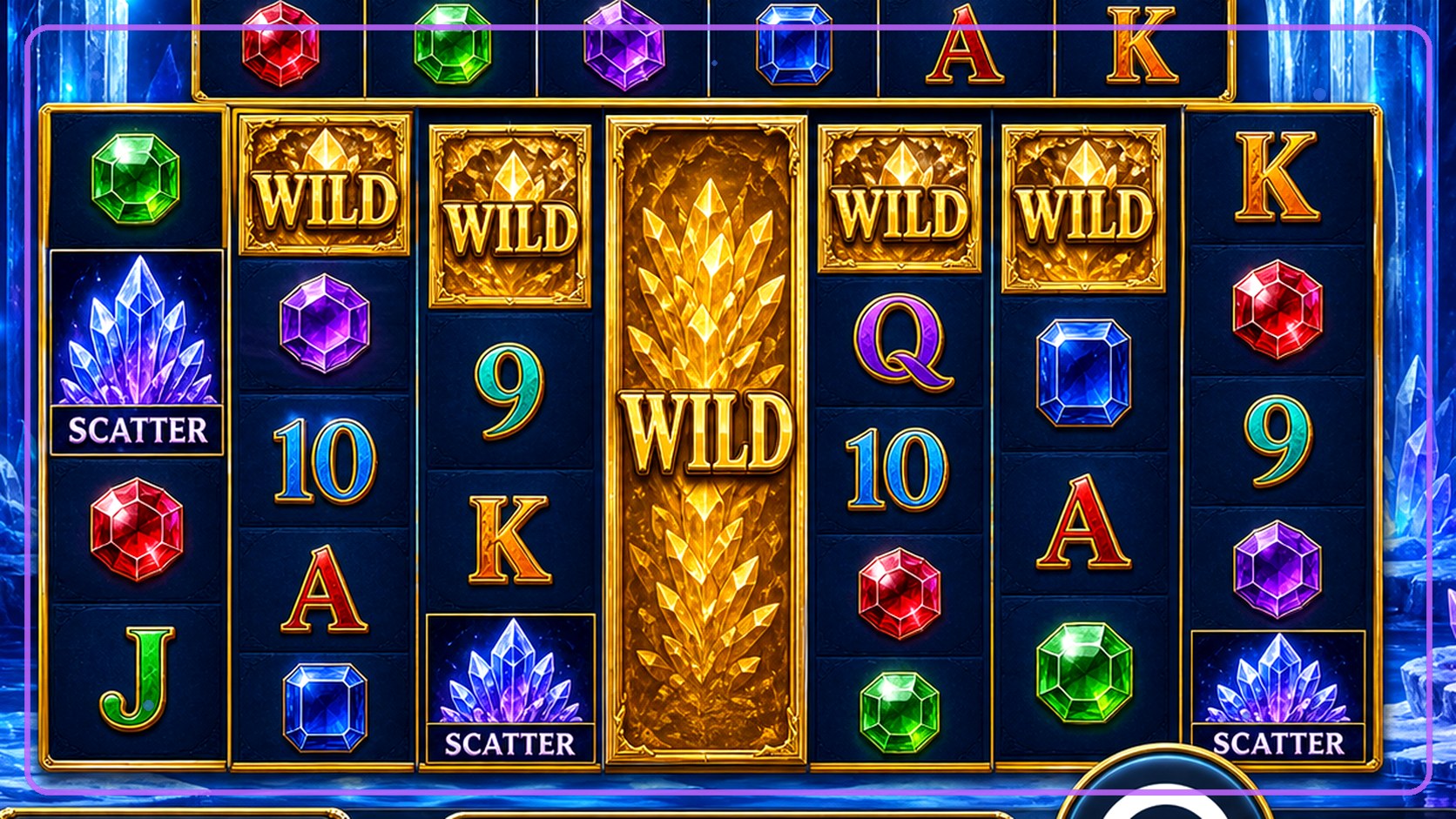
The second picture enlarges jewel symbols, card ranks and the top row so the changing reel heights and adjacency rule can be read more easily.

Its job is to make phone layout, symbol hierarchy and control placement easier to discuss. The written rules remain the authority for every cash calculation.

Picture Three: Wild, Scatter and Multiplier

The third picture focuses on an expanding golden Wild, three Scatters and a x3 Tumble marker. Those positions explain the feature vocabulary without claiming a real 3x award.

A live history panel should show more than any promotional still: original stake, component awards, modifiers and final credit. That record is the correct place to audit settlement.

Cavern survey 19: Sound Design and Perceived Pace

cold mechanical escalation can be strengthened through layered music, reel-stop cues and short feature stingers. Sound is useful when it marks a trigger or completed calculation. It becomes less useful when every partial return receives the same fanfare as a clear profit.

Try several rounds with audio lowered. If the board still communicates outcome, the interface is doing its job. If the result becomes ambiguous without a voice line or long count-up, the visual feedback needs more attention. Audio should confirm settlement, not replace the numbers.

Cavern survey 20: Landscape Play and Thumb Reach

A horizontal phone gives the frozen crystal cavern room on both sides of the reels. The central board remains large while settings, stake controls and spin can occupy the lower band. This arrangement works best when the largest button sits away from the minus and plus controls.

Before rapid play, rotate the device, enter full screen and check the total-stake field after one adjustment. Browser bars and system gestures can cover edge controls. A test spin at the minimum setting confirms that the hit boxes match the visible buttons and that no accidental Max Bet control sits beneath the thumb.

Cavern survey 21: Portrait Mode Is a Compromise

Portrait layout may scale the entire game down or reorganize controls beneath the grid. Tiny payline markers and condensed help text are the first casualties. The screen can remain playable, yet accurate rule reading becomes harder when the table requires repeated zooming or horizontal swipes.

Use portrait mode for quick navigation, not for the first rules check. Landscape is the better place to compare total stake, balance and win because all three can remain visible together. The relationship between those numbers matters more than keeping the device in one hand.

Cavern survey 22: Performance on Mid-Range Phones

The artwork uses multiple layers, large character cutouts and particle effects. On a mid-range handset, watch for delayed button response after a count-up, audio falling out of step with the reels or a stake change taking effect one round late. Those are interface problems, not signs of altered probability.

Close other heavy apps and use a stable connection during the first session. If the client reconnects, verify balance and the last completed round in history before spinning again. A frozen animation can recover after the server has already settled the result, so the account record takes priority over the last visible frame.

Cavern survey 23: Stake Controls Deserve More Attention Than the Mascot

A visible Megaways count and rising multiplier can make the current cascade feel like stored progress even though both reset according to the rule state. The most useful habit is to read total stake after every change and before the first rapid sequence. Bet per line, coin value and total bet may occupy separate fields, and altering one can multiply the final debit.

A planned session should be written in money, spins and time. Divide the session amount by the intended number of paid rounds to find a workable average stake. Free actions do not add a new debit unless the client states a purchase. This arithmetic is dull, but it controls exposure more reliably than any theme-based hunch.

Cavern survey 24: RTP Belongs to Turnover, Not a Short Run

Once the deployed RTP is known, interpret it as a long-run model ratio. If the help page lists 96 percent, theoretical cost is four units per hundred units of turnover. That sentence is an example of the calculation, not a claim that this version uses 96 percent.

Turnover equals total paid stake across accepted rounds. A hundred spins at one unit create one hundred units of turnover even if several free actions appear between them. A short session may finish far above or below the model ratio because random outcomes do not settle into a neat percentage on demand.

Cavern survey 25: Volatility Is About Distribution

Volatility describes how payout value is spread across outcomes. A higher band usually places more weight in less common large results; a lower band usually returns more of its value through smaller payments. The label does not state when a feature will arrive or how long a losing sequence can last.

Without an official band, infer nothing from cold mechanical escalation. A calm fruit village can use severe math, and a battlefield can use a mild distribution. After the label is found, use it to size stake and session length, not to forecast the next reel stop.

Cavern survey 26: Maximum Win Needs a Denominator

Secondary reviews list a 10000x maximum. Confirm the figure, total-bet denominator and cash cap in the deployed client before repeating it as the Philippine version limit.

The upper bound does not state the frequency of long Tumble chains, expanded Wild reels or twenty-spin triggers. It remains a boundary, not a session target.

Cavern survey 27: A Clean Demo Test in Thirty Paid Rounds

Use the minimum fixed stake and create one row for each paid round. Record starting balance, debit, base credit, feature credit, ending balance and any meter change. Keep free actions inside the row of the spin that triggered them. This format exposes the money flow without treating a tiny sample as statistical proof.

Thirty rounds are enough to learn button behavior, symbol settlement and feature messages. They are not enough to estimate RTP or trigger frequency. The purpose is mechanical literacy. Stop the test once each major control has been checked; more spins do not turn an informal sample into certification.

Cavern survey 28: How to Audit a Bonus From Start to Finish

Capture the trigger screen, starting counter, carried stake and opening multiplier. Then note each retrigger, held symbol, expanding reel or meter reset. At the end, compare the feature total with the history record and final balance. Every free action should trace back to one paid round.

If a purchase button exists, treat it as a separate bet mode. Record its price as the full stake for that round and read its RTP entry independently if the client lists one. A purchased feature may use the same animation while carrying a different cost structure.

Cavern survey 29: Common Misreads Around Crystal Caverns Megaways

The first misread is assuming that Megaways states the unconditional top award. The second is assigning premium status solely from symbol size. The third is treating a filling Megaways counter and rising Tumble multiplier as proof that a feature is due. The fourth is calling every substitute a multiplier Wild without checking the rules.

The fifth is copying an RTP from an unrelated review. The sixth is counting free actions as fresh paid spins. The seventh is judging profit from the win banner instead of balance movement. Each mistake disappears when the player keeps the stake field, history panel and help page in the same audit.

Cavern survey 30: What Philippine Players Should Verify

A Philippine listing may use peso values, wallet credits or a converted coin display. Confirm the minimum and maximum total stake, not merely coin size. Check that the operator names Pragmatic Play as the studio, and compare the logo with the official key art before assuming that a similarly named title is the same product.

Also read local rules for feature purchases, autoplay, session reminders and cash limits. These controls belong to the operator build and jurisdiction. A screenshot from another market can explain layout, but it cannot establish the available stake range or certified return in a Philippine account.

Cavern survey 31: Who Gets the Most From This Theme

Readers who like variable reel heights, repeated Tumbles and feature states in which a multiplier can climb through one uninterrupted sequence will find the presentation immediately legible. The theme also suits short review sessions because the visual hierarchy can be judged quickly. That does not make the mathematical profile suitable for every budget; the actual volatility and minimum total stake still control that decision.

Anyone who dislikes dense side art or loud event effects should test the sound and fast-play controls first. A strong theme can be a reason to open a demo, but it is not a reason to ignore the paytable. Interest in the artwork and comfort with the stake are separate choices.

Cavern survey 32: A Practical Decision Checklist

Before real play, confirm the exact title, studio, RTP, volatility, win method, Wild exceptions, Scatter route, feature trigger, multiplier scope, maximum-win denominator and cash cap. Then set a total session amount and a stopping time. If any critical rule remains hidden, keep the title in demo mode.

During play, watch balance rather than animation. After play, compare opening balance, deposits, withdrawals and ending balance with the history log. This checklist does not change random results. It changes how clearly the cost and settlement can be seen.

Cavern survey 33: Final Reading: Theme First, Math Before Money

Crystal Caverns Megaways earns its complexity through interaction rather than decoration. Variable reels create the route count, Tumbles extend a settled spin, expanding Wilds reshape columns and the multiplier determines how later parts of the same sequence are valued

Crystal Caverns Megaways earns attention through cold mechanical escalation and a tightly coordinated ice blue, violet crystal, emerald and reflective gold palette. The next step is not a larger stake; it is the local information screen. Confirm the deployed math, test the controls at minimum value and treat every visual promise as a question that the rules must answer.

Cavern survey 34: Separating Hit Rate From Profit Rate

A hit is any result the rules count as a payment. Profit requires the credited amount to exceed the full stake for that paid round. A title can register frequent small hits while the balance declines. Without an official hit-frequency figure, the only safe statement is that the two rates are not interchangeable.

For a demo log, mark return ratios below 1x, exactly 1x and above 1x in separate columns. This reveals how many recorded wins were partial returns. It still does not predict future play, but it gives a much clearer account of the sample than a simple count of flashing win messages.

Cavern survey 35: Near Misses Are Animation, Not Progress

A bonus icon stopping just outside a payline or a premium symbol passing during reel motion can feel meaningful. Unless the written rule stores that event, it has no carry-over value. The next accepted round is not improved because the previous animation looked close.

The same caution applies to two trigger symbols when three are required. They may create suspense, yet their payment and stored effect depend entirely on the table. Record what was credited, then clear the image from the decision about the next stake.

Cavern survey 36: Fast Play Changes Exposure Speed

Fast play shortens animation; it does not normally change the random model. Its financial effect comes from time. More paid rounds can fit into the same minute, so the balance may move faster even though the stake per round stays fixed.

Measure pace before enabling it. Ten ordinary rounds on standard speed and ten on fast speed reveal the difference in turnover per minute. If the faster rate breaks the planned session limit, lower the stake or return to standard timing rather than relying on attention alone.

Cavern survey 37: Autoplay Needs Stop Conditions

Where autoplay is available, set a round count and use any loss, win or single-award limits shown by the client. Read those fields carefully because some are cash values while others are stake multipliers. An empty field may mean no automatic stop for that condition.

Remain present during automated rounds. Network reconnection, a feature choice or a changed balance can pause the sequence. Autoplay is a convenience control, not a budget system, and it does not make a long sample more likely to follow the theoretical return.

Cavern survey 38: Responsible Play in Plain Numbers

Set a sum that can be lost without affecting bills, savings or debt payments. Do not borrow to play, do not chase a prior loss and do not treat a rare large result as income. Time reminders and deposit limits are useful because strong game art can blur the length of a session.

If play stops feeling optional, close the client and use the operator exclusion or limit tools. The clearest review of any slot ends with the same fact: outcomes are random, the house keeps a mathematical margin over long turnover and no visual pattern creates a reliable edge.
Por Fairy Editorial - 20 Aug 2026
Big Bass Splash Review: The Fisherman Ladder Behind the Bright Lake
Grande Splash de Bass
Big Bass Splash Review: The Fisherman Ladder Behind the Bright Lake

Big Bass Splash makes its central mechanism visible early: fisherman collection ladder and free-spin counter. The studio also states that every fourth collected fisherman adds ten spins and raises the multiplier through 2 times, 3 times and then 10 times. The useful question is not how loud the feature looks, but how each debit becomes a traceable credit. Pragmatic Play and Reel Kingdom publish a five-reel, three-row game with ten paylines, a 96.71 percent catalogue return, high volatility, a 5,000-times ceiling, 10, 15 or 20 free spins from three, four or five Scatters, as many as five pre-feature modifiers and a fisherman Wild that collects visible money fish. Exact regional terms still belong to the running client. All three pictures are original horizontal reconstructions informed by published mechanics. They are not Pragmatic Play or Reel Kingdom screenshots, and the fish values do not represent a tested outcome. This review uses a strict evidence order. The deployed help screen ranks first, then a studio sheet, studio product page, regulated operator rules and finally independent catalogues. Artwork proves theme and identity; it does not prove reel strips, probability, feature frequency or an operator return setting. No paid wager was placed and no age gate was bypassed. The accessible pages did not expose a legally open client that could be tested without confirmation, so there is no claimed personal hit rate, balance result or bonus sample. Published mechanics are mapped to checks that can be repeated when the Philippine build is opened by an eligible user. The three wide pictures keep the discussion concrete on a phone-shaped canvas. Their values, counters and positions are explanatory props. They must not be presented as original studio screenshots or as evidence of a win.

A useful test session should therefore be recorded as a sequence rather than remembered as a mood. Note the selected stake, starting balance, round identifier, ordinary line or ways return, feature entry cost, each modifier, every counter movement and the final credited amount. That record cannot predict later rounds, but it can expose a misunderstood rule, a missed reset or a display total that needs support review. The same discipline applies to comparisons with related titles. Shared characters and familiar symbols do not guarantee shared mathematics. A sequel may change its reel strips, return setting, bonus price, maximum award or retrigger schedule while preserving almost the same artwork. This article treats the exact named version as its own product and avoids transferring assumptions from neighbouring games in the catalogue.

Casting Before the First Debit

Big Bass Splash opens with practical lakeside bookkeeping. The bearded fisherman collector Wild and bass Scatters, money fish, tackle boxes, rods, dragonflies, card ranks and a monster truck are not background ornaments; they form a visual hierarchy that tells the eye where to look before any rule has been read. The reel area sits inside that hierarchy, so symbols remain distinct from the scenery instead of dissolving into it.

That first reading matters on a phone. A slot may spend heavily on illustration and still fail if the stake, spin control or settled result is hard to locate. Here the strongest idea is not mere decoration. It is the way clear lake blue, pine green, orange-red and dockside wood separates the game board, framing art and controls into layers.

The Version Confirmed by the Studios

Pragmatic Play and Reel Kingdom publish a five-reel, three-row game with ten paylines, a 96.71 percent catalogue return, high volatility, a 5,000-times ceiling, 10, 15 or 20 free spins from three, four or five Scatters, as many as five pre-feature modifiers and a fisherman Wild that collects visible money fish. The studio also states that every fourth collected fisherman adds ten spins and raises the multiplier through 2 times, 3 times and then 10 times.

These published figures define the review frame. The active information panel still outranks catalogue copy for the return variant, stake range, cash limit and any disabled feature in the operator build.

What 96.71 Percent Actually Describes

The studio lists 96.71 percent for the principal configuration. Lower operator variants are known to exist, so the number printed in the loaded help screen is the one that applies.

High volatility fits a design that concentrates much of its advertised potential in free spins and later fisherman levels. It says nothing about when two Scatters will receive assistance or when three will land.

Splash Is More Than a New Coat of Paint

The word Splash is the headline hook. It raises an obvious question: does it describe a multiplier, a progression, a visual motif or simply the scale of the story? Only the help screen can answer that. A number or power word in a logo is not automatically the highest cash ratio for a paid round.

Before treating the title as a promise, locate the line that defines it. Check the triggering symbols, the stage at which the value applies, any stake multiplier, the cap on simultaneous wins and any separate cash ceiling. If those conditions are absent, the name should remain a marketing label rather than a calculation.

Five Reels and Ten Fixed Lines

The art uses the confirmed five-by-three, ten-line cabinet. Exact stake limits and return variants can differ by operator, so the information panel loaded in the Philippine client must be checked before play.

The board shape is only the first part of settlement. A player must also verify direction, minimum match length, line or ways unit, Wild exclusions and how simultaneous components are added.

Fish, Tackle and the Monster Truck

The theme naturally divides the reel set into character or object symbols, special icons and 10 through Ace card ranks. bass Scatters, money fish, tackle boxes, rods, dragonflies, card ranks and a monster truck carry more visual weight than the letters and numbers. That weight usually signals premium status, but the paytable may rank two similar objects very differently. Size and shine are clues, never final values.

Read every payout in the unit used by the game. Some tables show bet-per-line units; others use total stake. A five-of-a-kind figure can appear ten or twenty times larger if the unit is misunderstood. The cash meter after a test spin is useful, but the written help panel should settle the conversion.

Card Ranks Beneath the Lake Art

10 through Ace card ranks occupy a large share of ordinary reel time in the editorial layout. They create visual breathing room around the premium art and make small combinations quick to recognize. Their role in the mathematical model may be larger than their small paytable values suggest because frequency and value are separate parts of return.

A low-symbol hit can light the grid while returning less than the amount staked. That is a paid result, not necessarily a profitable round. The correct comparison is final credit divided by the full spin cost. Animation length, coin count and sound volume do not change that ratio.

Following One Payline to Settlement

Large portraits and objects such as bass Scatters, money fish, tackle boxes, rods, dragonflies, card ranks and a monster truck can dominate the frame. The practical test is to follow one settled combination from its first symbol to its last without relying on flashing borders. Clear spacing between reels, consistent icon silhouettes and a visible route make the result easier to audit.

If several awards arrive together, open the win breakdown or history panel. One total may contain multiple lines, an anywhere payment and a modifier. Treating the largest symbol on screen as the sole cause can produce a false reading of the rule, especially when a substitute or multiplier is also present.

The Fisherman Wild Has Two Jobs

The fisherman substitutes as a Wild for ordinary line symbols. In free spins he also collects the values displayed on every money fish visible in the same settled screen.

A fish value is not won merely because it appears. The collection condition requires the fisherman in that action, and the multiplier level at settlement determines the credited amount.

Bass Scatters and the Two-Scatter Assist

Three, four or five bass Scatters start 10, 15 or 20 free spins. When exactly two appear in the base game, reels may nudge or respin and a hook can reveal another position in search of the third.

That assistance belongs to the current round. It is not a stored near-miss counter, and repeated two-Scatter screens do not make the next trigger mathematically due.

The Fisherman Ladder

Every fourth fisherman collected retriggers ten free spins. The first checkpoint moves collection to 2 times, the second to 3 times and the third to 10 times.

Count fishermen, not fish, for level progress. Several money fish with one Wild produce one fisherman step even though their displayed values are all collected.

Base Spins Before the Catch

Many reviews rush past the paid reels and treat the bonus as the only meaningful part. That misses the money path. Base spins create nearly all turnover, settle small and medium awards, and decide how long a balance remains available. A rare feature cannot repair a stake level that is too high for the intended session.

Big Bass Splash needs ordinary results that are readable at a glance. A clean board lets the user distinguish a no-win, a partial return and a profit without waiting for a long count-up. That clarity is especially important when the surrounding sunlit freshwater lake and fishing dock is busy and the screen uses strong motion.

The Modifier Draw Before Free Spins

Before free spins begin, the feature can receive zero to five modifiers. Published examples include extra fishermen, more money fish, extra spins, hooks, dynamite, bazookas or direct advancement to level two.

The draw changes starting conditions but does not guarantee a profitable feature. Write down every modifier before the first action so its real contribution can be separated from ordinary luck.

How 2x, 3x and 10x Apply

The 2-times, 3-times and 10-times values apply to collected money fish at the corresponding ladder level. They should not be applied to base line wins or fish collected earlier.

When the fourth fisherman both collects fish and advances the level, the help sequence determines which multiplier applies to that same screen. The history record resolves any ambiguity.

Putting the 5,000x Cap in Context

Clients often label results with tiers such as big, mega or super. Those labels are commonly based on the ratio between win and current stake. They do not prove that the result reached the mathematical ceiling. The count-up may also stop at a cash cap even when the theoretical symbol total is higher.

To calculate a genuine ratio, divide the credited result by the total stake removed for the paid round. Include free follow-up actions inside that same round unless the rules state otherwise. This method turns a loud presentation into a comparable number and avoids confusing coins on screen with peso value.

Picture One: Lakeside Reconstruction

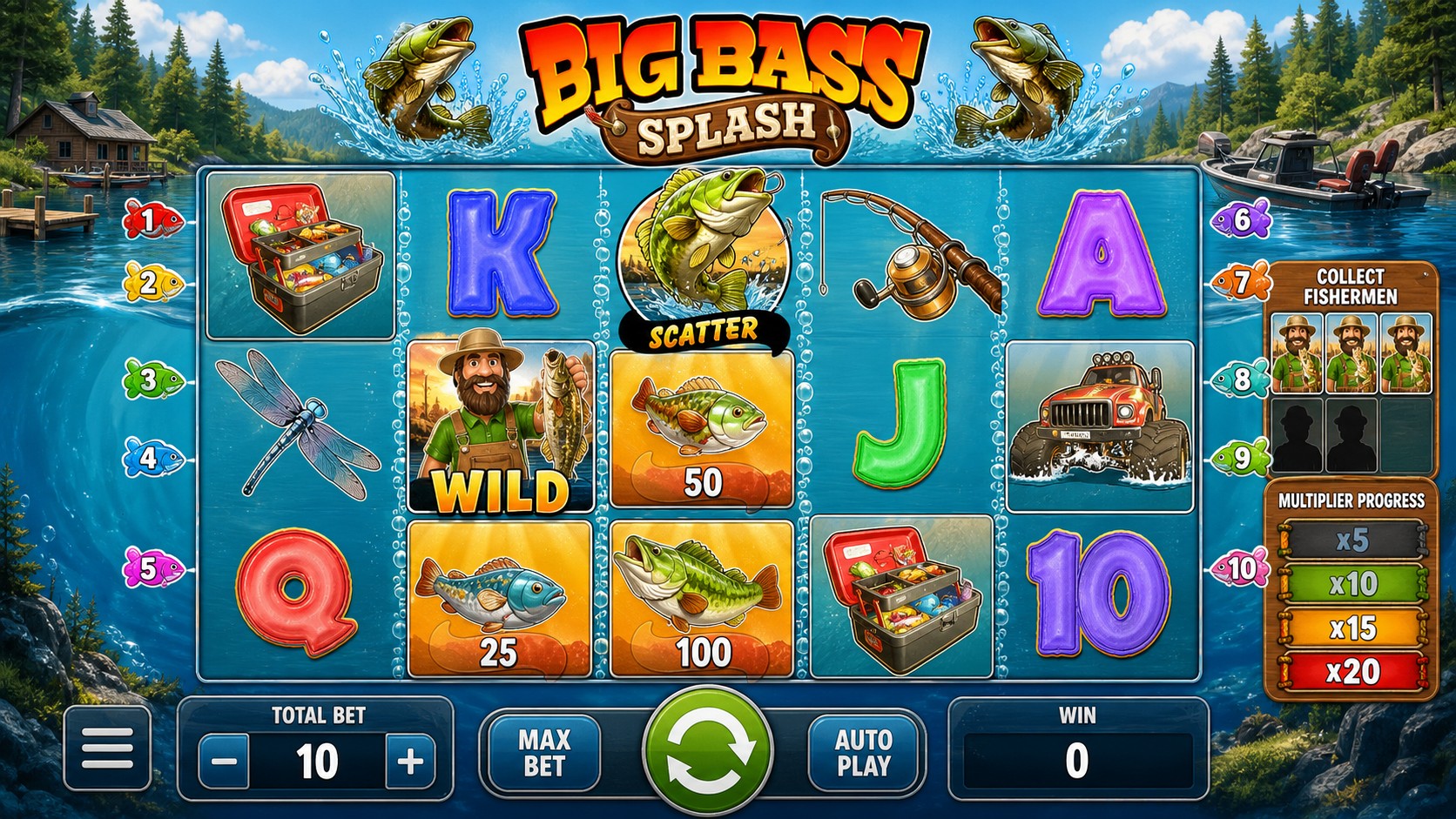
The first picture reconstructs the full lakeside interface with a fisherman Wild, bass Scatter, money fish and monster truck. The arrangement is newly made for analysis and is not a recorded spin.

The illustration belongs to the editorial layer. It cannot certify probability, reel strips, a balance or a real feature trigger.

Picture Two: Collector and Money Fish

The second picture zooms toward the collector and money symbols. It clarifies that a fisherman must land with fish in the same spin for collection, while the displayed values remain props.

The close view helps separate symbol roles and screen zones. The client history remains the correct evidence for a settled round.

Picture Three: Modifier and Retrigger Map

The third picture emphasizes the modifier panel, fisherman checkpoints and multiplier ladder. It is a map of published possibilities, not evidence that all modifiers appeared together.

The image turns a complicated rule tree into visible parts, but only the live rules establish which parts can coexist.

Fishing ledger 19: Sound Design and Perceived Pace

practical lakeside bookkeeping can be strengthened through layered music, reel-stop cues and short feature stingers. Sound is useful when it marks a trigger or completed calculation. It becomes less useful when every partial return receives the same fanfare as a clear profit.

Try several rounds with audio lowered. If the board still communicates outcome, the interface is doing its job. If the result becomes ambiguous without a voice line or long count-up, the visual feedback needs more attention. Audio should confirm settlement, not replace the numbers.

Fishing ledger 20: Landscape Play and Thumb Reach

A horizontal phone gives the sunlit freshwater lake and fishing dock room on both sides of the reels. The central board remains large while settings, stake controls and spin can occupy the lower band. This arrangement works best when the largest button sits away from the minus and plus controls.

Before rapid play, rotate the device, enter full screen and check the total-stake field after one adjustment. Browser bars and system gestures can cover edge controls. A test spin at the minimum setting confirms that the hit boxes match the visible buttons and that no accidental Max Bet control sits beneath the thumb.

Fishing ledger 21: Portrait Mode Is a Compromise

Portrait layout may scale the entire game down or reorganize controls beneath the grid. Tiny payline markers and condensed help text are the first casualties. The screen can remain playable, yet accurate rule reading becomes harder when the table requires repeated zooming or horizontal swipes.

Use portrait mode for quick navigation, not for the first rules check. Landscape is the better place to compare total stake, balance and win because all three can remain visible together. The relationship between those numbers matters more than keeping the device in one hand.

Fishing ledger 22: Performance on Mid-Range Phones

The artwork uses multiple layers, large character cutouts and particle effects. On a mid-range handset, watch for delayed button response after a count-up, audio falling out of step with the reels or a stake change taking effect one round late. Those are interface problems, not signs of altered probability.

Close other heavy apps and use a stable connection during the first session. If the client reconnects, verify balance and the last completed round in history before spinning again. A frozen animation can recover after the server has already settled the result, so the account record takes priority over the last visible frame.

Fishing ledger 23: Stake Controls Deserve More Attention Than the Mascot

The two-Scatter assistance, random modifier draw and fisherman ladder can make a near-trigger or partial collection feel like durable progress even though each paid round settles independently. The most useful habit is to read total stake after every change and before the first rapid sequence. Bet per line, coin value and total bet may occupy separate fields, and altering one can multiply the final debit.

A planned session should be written in money, spins and time. Divide the session amount by the intended number of paid rounds to find a workable average stake. Free actions do not add a new debit unless the client states a purchase. This arithmetic is dull, but it controls exposure more reliably than any theme-based hunch.

Fishing ledger 24: RTP Belongs to Turnover, Not a Short Run

Once the deployed RTP is known, interpret it as a long-run model ratio. If the help page lists 96 percent, theoretical cost is four units per hundred units of turnover. That sentence is an example of the calculation, not a claim that this version uses 96 percent.

Turnover equals total paid stake across accepted rounds. A hundred spins at one unit create one hundred units of turnover even if several free actions appear between them. A short session may finish far above or below the model ratio because random outcomes do not settle into a neat percentage on demand.

Fishing ledger 25: Volatility Is About Distribution

Volatility describes how payout value is spread across outcomes. A higher band usually places more weight in less common large results; a lower band usually returns more of its value through smaller payments. The label does not state when a feature will arrive or how long a losing sequence can last.

Without an official band, infer nothing from practical lakeside bookkeeping. A calm fruit village can use severe math, and a battlefield can use a mild distribution. After the label is found, use it to size stake and session length, not to forecast the next reel stop.

Fishing ledger 26: Maximum Win Needs a Denominator

The studio publishes a 5,000-times maximum. This cap includes the feature result rather than sitting on top of it as a separate prize.

A fish may display a very large value, but the full round cannot exceed the stated boundary and may also face a jurisdictional cash ceiling. The cap is not evidence that high-value fish appear often.

Fishing ledger 27: A Clean Demo Test in Thirty Paid Rounds

Use the minimum fixed stake and create one row for each paid round. Record starting balance, debit, base credit, feature credit, ending balance and any meter change. Keep free actions inside the row of the spin that triggered them. This format exposes the money flow without treating a tiny sample as statistical proof.

Thirty rounds are enough to learn button behavior, symbol settlement and feature messages. They are not enough to estimate RTP or trigger frequency. The purpose is mechanical literacy. Stop the test once each major control has been checked; more spins do not turn an informal sample into certification.

Fishing ledger 28: How to Audit a Bonus From Start to Finish

Capture the trigger screen, starting counter, carried stake and opening multiplier. Then note each retrigger, held symbol, expanding reel or meter reset. At the end, compare the feature total with the history record and final balance. Every free action should trace back to one paid round.

If a purchase button exists, treat it as a separate bet mode. Record its price as the full stake for that round and read its RTP entry independently if the client lists one. A purchased feature may use the same animation while carrying a different cost structure.

Fishing ledger 29: Common Misreads Around Big Bass Splash

The first misread is assuming that Splash states the unconditional top award. The second is assigning premium status solely from symbol size. The third is treating a filling fisherman collection ladder and free-spin counter as proof that a feature is due. The fourth is calling every substitute a multiplier Wild without checking the rules.

The fifth is copying an RTP from an unrelated review. The sixth is counting free actions as fresh paid spins. The seventh is judging profit from the win banner instead of balance movement. Each mistake disappears when the player keeps the stake field, history panel and help page in the same audit.

Fishing ledger 30: What Philippine Players Should Verify

A Philippine listing may use peso values, wallet credits or a converted coin display. Confirm the minimum and maximum total stake, not merely coin size. Check that the operator names Reel Kingdom Games as the studio, and compare the logo with the official key art before assuming that a similarly named title is the same product.

Also read local rules for feature purchases, autoplay, session reminders and cash limits. These controls belong to the operator build and jurisdiction. A screenshot from another market can explain layout, but it cannot establish the available stake range or certified return in a Philippine account.

Fishing ledger 31: Who Gets the Most From This Theme

Readers who know the Big Bass family but want this 2022 version separated from later 1000, Megaways and Hold and Spinner editions will find the presentation immediately legible. The theme also suits short review sessions because the visual hierarchy can be judged quickly. That does not make the mathematical profile suitable for every budget; the actual volatility and minimum total stake still control that decision.

Anyone who dislikes dense side art or loud event effects should test the sound and fast-play controls first. A strong theme can be a reason to open a demo, but it is not a reason to ignore the paytable. Interest in the artwork and comfort with the stake are separate choices.

Fishing ledger 32: A Practical Decision Checklist

Before real play, confirm the exact title, studio, RTP, volatility, win method, Wild exceptions, Scatter route, feature trigger, multiplier scope, maximum-win denominator and cash cap. Then set a total session amount and a stopping time. If any critical rule remains hidden, keep the title in demo mode.

During play, watch balance rather than animation. After play, compare opening balance, deposits, withdrawals and ending balance with the history log. This checklist does not change random results. It changes how clearly the cost and settlement can be seen.

Fishing ledger 33: Final Reading: Theme First, Math Before Money

Big Bass Splash adds meaningful structure to a familiar formula. The modifier draw changes the starting conditions, the fisherman count creates three retrigger checkpoints and the 10-times final level gives the last phase a sharply different value profile

Big Bass Splash earns attention through practical lakeside bookkeeping and a tightly coordinated clear lake blue, pine green, orange-red and dockside wood palette. The next step is not a larger stake; it is the local information screen. Confirm the deployed math, test the controls at minimum value and treat every visual promise as a question that the rules must answer.

Fishing ledger 34: Separating Hit Rate From Profit Rate

A hit is any result the rules count as a payment. Profit requires the credited amount to exceed the full stake for that paid round. A title can register frequent small hits while the balance declines. Without an official hit-frequency figure, the only safe statement is that the two rates are not interchangeable.

For a demo log, mark return ratios below 1x, exactly 1x and above 1x in separate columns. This reveals how many recorded wins were partial returns. It still does not predict future play, but it gives a much clearer account of the sample than a simple count of flashing win messages.

Fishing ledger 35: Near Misses Are Animation, Not Progress

A bonus icon stopping just outside a payline or a premium symbol passing during reel motion can feel meaningful. Unless the written rule stores that event, it has no carry-over value. The next accepted round is not improved because the previous animation looked close.

The same caution applies to two trigger symbols when three are required. They may create suspense, yet their payment and stored effect depend entirely on the table. Record what was credited, then clear the image from the decision about the next stake.

Fishing ledger 36: Fast Play Changes Exposure Speed

Fast play shortens animation; it does not normally change the random model. Its financial effect comes from time. More paid rounds can fit into the same minute, so the balance may move faster even though the stake per round stays fixed.

Measure pace before enabling it. Ten ordinary rounds on standard speed and ten on fast speed reveal the difference in turnover per minute. If the faster rate breaks the planned session limit, lower the stake or return to standard timing rather than relying on attention alone.

Fishing ledger 37: Autoplay Needs Stop Conditions

Where autoplay is available, set a round count and use any loss, win or single-award limits shown by the client. Read those fields carefully because some are cash values while others are stake multipliers. An empty field may mean no automatic stop for that condition.

Remain present during automated rounds. Network reconnection, a feature choice or a changed balance can pause the sequence. Autoplay is a convenience control, not a budget system, and it does not make a long sample more likely to follow the theoretical return.

Fishing ledger 38: Responsible Play in Plain Numbers

Set a sum that can be lost without affecting bills, savings or debt payments. Do not borrow to play, do not chase a prior loss and do not treat a rare large result as income. Time reminders and deposit limits are useful because strong game art can blur the length of a session.

If play stops feeling optional, close the client and use the operator exclusion or limit tools. The clearest review of any slot ends with the same fact: outcomes are random, the house keeps a mathematical margin over long turnover and no visual pattern creates a reliable edge.
Por Fairy Editorial - 19 Aug 2026
Lekka Fruittie Review: Market-Fresh Symbols With Conflicting Numbers
Lekka Fruittie
Lekka Fruittie Review: Market-Fresh Symbols With Conflicting Numbers

Lekka Fruittie starts with a title that makes the theme clear before a reel turns. The title is consistently framed as a South African fruit-market slot, but the conflicting mathematical summaries prevent one clean specification from being treated as final. That gives the article a visual direction, but not permission to fill missing rules with assumptions. Public casino pages associate Lekka Fruittie with GameOn Studios and describe a five-by-three grid, 15 paylines, both-way wins, duplicating Wilds and a 95.59 percent return; a secondary catalogue instead lists 95.2 percent and 10 ways. Exact RTP, volatility, feature frequency and maximum-award conditions therefore remain version checks wherever the public record is incomplete or contradictory. All three pictures are editorial reconstructions based on the public fruit-market description. Attempts to download the published casino artwork were blocked, so no third-party image is presented here as an official screenshot.

Walking Into the Fruit Market

Lekka Fruittie opens with bright market-day bustle. The open-air produce stalls rather than a human mascot and litchis, avocados, pineapples, bananas, oranges, watermelons, BARs and lucky sevens are not background ornaments; they form a visual hierarchy that tells the eye where to look before any rule has been read. The reel area sits inside that hierarchy, so symbols remain distinct from the scenery instead of dissolving into it.

That first reading matters on a phone. A slot may spend heavily on illustration and still fail if the stake, spin control or settled result is hard to locate. Here the strongest idea is not mere decoration. It is the way leaf green, citrus orange, pineapple gold and clear sky blue separates the game board, framing art and controls into layers.

The Public Description and Its Conflict

Public casino pages associate Lekka Fruittie with GameOn Studios and describe a five-by-three grid, 15 paylines, both-way wins, duplicating Wilds and a 95.59 percent return; a secondary catalogue instead lists 95.2 percent and 10 ways. The title is consistently framed as a South African fruit-market slot, but the conflicting mathematical summaries prevent one clean specification from being treated as final. This is the firm boundary of the evidence used here.

A catalogue image can establish identity and art direction. It cannot establish the exact RTP setting, volatility band, reel mathematics, bet limits or highest award in every operator build. Those facts belong to the information panel of the version actually loaded.

95.59 Versus 95.2

No exact RTP is printed here because a first-party mathematical sheet for the deployed Philippine build was not available for direct inspection. Repeating a familiar percentage from another site would turn an information gap into false precision.

The same restraint applies to volatility, hit frequency, bonus frequency and maximum win. A secondary directory may list figures, but the running help page and operator rules take priority because certified configurations and regional limits can differ.

What Fruittie Means on the Reels

The word Fruittie is the headline hook. It raises an obvious question: does it describe a multiplier, a progression, a visual motif or simply the scale of the story? Only the help screen can answer that. A number or power word in a logo is not automatically the highest cash ratio for a paid round.

Before treating the title as a promise, locate the line that defines it. Check the triggering symbols, the stage at which the value applies, any stake multiplier, the cap on simultaneous wins and any separate cash ceiling. If those conditions are absent, the name should remain a marketing label rather than a calculation.

Five by Three, but Lines or Ways

Start with the shape of the board and the rule used to recognize a result. A wide image can represent fixed paylines, adjacent ways, clusters, symbol counts or another method. The visible columns alone do not answer the question.

The editorial screen follows the widely repeated five-by-three description. Public pages disagree over 15 paylines versus 10 ways, making the information panel essential for defining direction, adjacency and the effect of any both-way rule.

Building the Produce Hierarchy

The theme naturally divides the reel set into character or object symbols, special icons and classic BAR and fruit icons. litchis, avocados, pineapples, bananas, oranges, watermelons, BARs and lucky sevens carry more visual weight than the letters and numbers. That weight usually signals premium status, but the paytable may rank two similar objects very differently. Size and shine are clues, never final values.

Read every payout in the unit used by the game. Some tables show bet-per-line units; others use total stake. A five-of-a-kind figure can appear ten or twenty times larger if the unit is misunderstood. The cash meter after a test spin is useful, but the written help panel should settle the conversion.

Classic BARs Beside Fresh Fruit

classic BAR and fruit icons occupy a large share of ordinary reel time in the editorial layout. They create visual breathing room around the premium art and make small combinations quick to recognize. Their role in the mathematical model may be larger than their small paytable values suggest because frequency and value are separate parts of return.

A low-symbol hit can light the grid while returning less than the amount staked. That is a paid result, not necessarily a profitable round. The correct comparison is final credit divided by the full spin cost. Animation length, coin count and sound volume do not change that ratio.

Reading Wins in Both Directions

Large portraits and objects such as litchis, avocados, pineapples, bananas, oranges, watermelons, BARs and lucky sevens can dominate the frame. The practical test is to follow one settled combination from its first symbol to its last without relying on flashing borders. Clear spacing between reels, consistent icon silhouettes and a visible route make the result easier to audit.

If several awards arrive together, open the win breakdown or history panel. One total may contain multiple lines, an anywhere payment and a modifier. Treating the largest symbol on screen as the sole cause can produce a false reading of the rule, especially when a substitute or multiplier is also present.

The Duplicating Wild Question

A Wild description is incomplete until three points are known: which symbols it copies, where it can land and if it carries its own value or multiplier. It may exclude Scatters, bonus icons or jackpots. Some Wilds expand or stay in place; others do nothing beyond substitution. The artwork cannot settle those exceptions.

When a Wild appears, compare the marked winning path with the natural symbols around it. Then check if the game pays the best valid combination or adds a separate Wild award. This small audit prevents a common error in which every decorated emblem is assumed to copy everything on the board.

Scatter Placement Still Needs the Manual

A Scatter generally counts across specified reels or anywhere on the grid, but the required count and eligible positions vary. Three matching icons might start a feature in one version and merely pay in another. Some titles require the first, third and fifth reels; others accept any three positions.

Record the full trigger screen before naming the rule. Count the symbols, note their reels and wait for the award message. If the next screen changes mode, check the starting counter and carried stake. One observed trigger explains a route; it does not estimate how often that route will happen.

A Fruit Counter Cannot Predict the Next Spin

any fruit or Wild counter in the client should be treated as an interface question, not a prediction. If the deployed client displays it, the help page must say what moves it, when it resets and if any progress survives the next paid round.

Watch one complete cycle before assigning meaning. A circle, gauge or counter may show collected symbols, a one-round modifier, a bonus threshold or only decorative state. A nearly full graphic does not prove that a feature is due.

The Base Market Before Any Modifier

Many reviews rush past the paid reels and treat the bonus as the only meaningful part. That misses the money path. Base spins create nearly all turnover, settle small and medium awards, and decide how long a balance remains available. A rare feature cannot repair a stake level that is too high for the intended session.

Lekka Fruittie needs ordinary results that are readable at a glance. A clean board lets the user distinguish a no-win, a partial return and a profit without waiting for a long count-up. That clarity is especially important when the surrounding sunny South African fruit market is busy and the screen uses strong motion.

What Duplication Must Change

the advertised duplicating-Wild behavior earns a separate name only if it changes a rule. It might alter the grid, symbol set, multiplier scope, number of actions or settlement method. A new background and louder sound are presentation changes, not new math.

Compare the help text before and after the mode begins. Record any carried stake, starting counter, retrigger condition and cap. If none of these elements changes, describe the event as an animation state rather than a distinct bonus mechanism.

Attaching a Multiplier to the Right Win

A multiplier can act on one symbol, one line, the current cascade, all wins in a free-spin round or the final feature total. Saying that a game has multipliers leaves the crucial calculation unanswered. The placement of the number and the wording of the win message usually reveal the scope.

Also check if several multipliers add or multiply together. Two visible 2x values could mean 4x, a combined 4x through addition, or separate modifiers on different awards. The history entry after settlement is the safest way to test. Never extrapolate the top result from a promotional badge alone.

A Market Celebration Is Not the Cap

Clients often label results with tiers such as big, mega or super. Those labels are commonly based on the ratio between win and current stake. They do not prove that the result reached the mathematical ceiling. The count-up may also stop at a cash cap even when the theoretical symbol total is higher.

To calculate a genuine ratio, divide the credited result by the total stake removed for the paid round. Include free follow-up actions inside that same round unless the rules state otherwise. This method turns a loud presentation into a comparable number and avoids confusing coins on screen with peso value.

Picture One: The Editorial Market

The first picture imagines Lekka Fruittie as a sunny produce market with a five-by-three reel board. It closely follows the public theme but is not GameOn Studios source art.

The picture belongs to the visual review only. It must never be used as a substitute for a paytable, probability statement or operator-specific stake range.

Picture Two: Fruit Grid Close-Up

The second picture moves toward the fruit grid and lower controls. The litchi, avocado, pineapple, banana and orange symbols illustrate hierarchy rather than certified payouts.

Its job is to make phone layout, symbol hierarchy and control placement easier to discuss. The written rules remain the authority for every cash calculation.

Picture Three: Comparing Classic and Produce Icons

The third picture enlarges fruit, BAR, seven and basket-Wild concepts to test scan speed. It does not document a duplicating Wild event or either version of the reported win method.

A live history panel should show more than any promotional still: original stake, component awards, modifiers and final credit. That record is the correct place to audit settlement.

Market notebook 19: Sound Design and Perceived Pace

bright market-day bustle can be strengthened through layered music, reel-stop cues and short feature stingers. Sound is useful when it marks a trigger or completed calculation. It becomes less useful when every partial return receives the same fanfare as a clear profit.

Try several rounds with audio lowered. If the board still communicates outcome, the interface is doing its job. If the result becomes ambiguous without a voice line or long count-up, the visual feedback needs more attention. Audio should confirm settlement, not replace the numbers.

Market notebook 20: Landscape Play and Thumb Reach

A horizontal phone gives the sunny South African fruit market room on both sides of the reels. The central board remains large while settings, stake controls and spin can occupy the lower band. This arrangement works best when the largest button sits away from the minus and plus controls.

Before rapid play, rotate the device, enter full screen and check the total-stake field after one adjustment. Browser bars and system gestures can cover edge controls. A test spin at the minimum setting confirms that the hit boxes match the visible buttons and that no accidental Max Bet control sits beneath the thumb.

Market notebook 21: Portrait Mode Is a Compromise

Portrait layout may scale the entire game down or reorganize controls beneath the grid. Tiny payline markers and condensed help text are the first casualties. The screen can remain playable, yet accurate rule reading becomes harder when the table requires repeated zooming or horizontal swipes.

Use portrait mode for quick navigation, not for the first rules check. Landscape is the better place to compare total stake, balance and win because all three can remain visible together. The relationship between those numbers matters more than keeping the device in one hand.

Market notebook 22: Performance on Mid-Range Phones

The artwork uses multiple layers, large character cutouts and particle effects. On a mid-range handset, watch for delayed button response after a count-up, audio falling out of step with the reels or a stake change taking effect one round late. Those are interface problems, not signs of altered probability.

Close other heavy apps and use a stable connection during the first session. If the client reconnects, verify balance and the last completed round in history before spinning again. A frozen animation can recover after the server has already settled the result, so the account record takes priority over the last visible frame.

Market notebook 23: Stake Controls Deserve More Attention Than the Mascot

A dense market full of ripe fruit can make frequent visual matches feel like profit even when several are only partial returns. The most useful habit is to read total stake after every change and before the first rapid sequence. Bet per line, coin value and total bet may occupy separate fields, and altering one can multiply the final debit.

A planned session should be written in money, spins and time. Divide the session amount by the intended number of paid rounds to find a workable average stake. Free actions do not add a new debit unless the client states a purchase. This arithmetic is dull, but it controls exposure more reliably than any theme-based hunch.

Market notebook 24: RTP Belongs to Turnover, Not a Short Run

Once the deployed RTP is known, interpret it as a long-run model ratio. If the help page lists 96 percent, theoretical cost is four units per hundred units of turnover. That sentence is an example of the calculation, not a claim that this version uses 96 percent.

Turnover equals total paid stake across accepted rounds. A hundred spins at one unit create one hundred units of turnover even if several free actions appear between them. A short session may finish far above or below the model ratio because random outcomes do not settle into a neat percentage on demand.

Market notebook 25: Volatility Is About Distribution

Volatility describes how payout value is spread across outcomes. A higher band usually places more weight in less common large results; a lower band usually returns more of its value through smaller payments. The label does not state when a feature will arrive or how long a losing sequence can last.

Without an official band, infer nothing from bright market-day bustle. A calm fruit village can use severe math, and a battlefield can use a mild distribution. After the label is found, use it to size stake and session length, not to forecast the next reel stop.

Market notebook 26: Maximum Win Needs a Denominator

A maximum written as 1000x or 5000x must say what x means. It may refer to total bet, coin value, feature stake or a base amount before an ante. Some clients also apply a fixed cash ceiling. The lower of the mathematical award and cash cap may be the amount actually credited.

Check if the cap ends the feature immediately or allows remaining actions to play without added credit. Also check if simultaneous line, Scatter and jackpot awards share one cap. A headline number without these conditions is incomplete and should never be used to set a spending target.

Market notebook 27: A Clean Demo Test in Thirty Paid Rounds

Use the minimum fixed stake and create one row for each paid round. Record starting balance, debit, base credit, feature credit, ending balance and any meter change. Keep free actions inside the row of the spin that triggered them. This format exposes the money flow without treating a tiny sample as statistical proof.

Thirty rounds are enough to learn button behavior, symbol settlement and feature messages. They are not enough to estimate RTP or trigger frequency. The purpose is mechanical literacy. Stop the test once each major control has been checked; more spins do not turn an informal sample into certification.

Market notebook 28: How to Audit a Bonus From Start to Finish

Capture the trigger screen, starting counter, carried stake and opening multiplier. Then note each retrigger, held symbol, expanding reel or meter reset. At the end, compare the feature total with the history record and final balance. Every free action should trace back to one paid round.

If a purchase button exists, treat it as a separate bet mode. Record its price as the full stake for that round and read its RTP entry independently if the client lists one. A purchased feature may use the same animation while carrying a different cost structure.

Market notebook 29: Common Misreads Around Lekka Fruittie

The first misread is assuming that Fruittie states the unconditional top award. The second is assigning premium status solely from symbol size. The third is treating a filling any fruit or Wild counter in the client as proof that a feature is due. The fourth is calling every substitute a multiplier Wild without checking the rules.

The fifth is copying an RTP from an unrelated review. The sixth is counting free actions as fresh paid spins. The seventh is judging profit from the win banner instead of balance movement. Each mistake disappears when the player keeps the stake field, history panel and help page in the same audit.

Market notebook 30: What Philippine Players Should Verify

A Philippine listing may use peso values, wallet credits or a converted coin display. Confirm the minimum and maximum total stake, not merely coin size. Check that the operator names GameOn Studios as the studio, and compare the logo with the official key art before assuming that a similarly named title is the same product.

Also read local rules for feature purchases, autoplay, session reminders and cash limits. These controls belong to the operator build and jurisdiction. A screenshot from another market can explain layout, but it cannot establish the available stake range or certified return in a Philippine account.

Market notebook 31: Who Gets the Most From This Theme

Readers who like classic fruit symbols but want a warmer market setting and a possible both-way twist will find the presentation immediately legible. The theme also suits short review sessions because the visual hierarchy can be judged quickly. That does not make the mathematical profile suitable for every budget; the actual volatility and minimum total stake still control that decision.

Anyone who dislikes dense side art or loud event effects should test the sound and fast-play controls first. A strong theme can be a reason to open a demo, but it is not a reason to ignore the paytable. Interest in the artwork and comfort with the stake are separate choices.

Market notebook 32: A Practical Decision Checklist

Before real play, confirm the exact title, studio, RTP, volatility, win method, Wild exceptions, Scatter route, feature trigger, multiplier scope, maximum-win denominator and cash cap. Then set a total session amount and a stopping time. If any critical rule remains hidden, keep the title in demo mode.

During play, watch balance rather than animation. After play, compare opening balance, deposits, withdrawals and ending balance with the history log. This checklist does not change random results. It changes how clearly the cost and settlement can be seen.

Market notebook 33: Final Reading: Theme First, Math Before Money

Lekka Fruittie has the clearest thematic brief of this batch and the sharpest data conflict. The contradiction between 15 paylines and 10 ways must be resolved in the running client before any strategy discussion starts

Lekka Fruittie earns attention through bright market-day bustle and a tightly coordinated leaf green, citrus orange, pineapple gold and clear sky blue palette. The next step is not a larger stake; it is the local information screen. Confirm the deployed math, test the controls at minimum value and treat every visual promise as a question that the rules must answer.

Market notebook 34: Separating Hit Rate From Profit Rate

A hit is any result the rules count as a payment. Profit requires the credited amount to exceed the full stake for that paid round. A title can register frequent small hits while the balance declines. Without an official hit-frequency figure, the only safe statement is that the two rates are not interchangeable.

For a demo log, mark return ratios below 1x, exactly 1x and above 1x in separate columns. This reveals how many recorded wins were partial returns. It still does not predict future play, but it gives a much clearer account of the sample than a simple count of flashing win messages.

Market notebook 35: Near Misses Are Animation, Not Progress

A bonus icon stopping just outside a payline or a premium symbol passing during reel motion can feel meaningful. Unless the written rule stores that event, it has no carry-over value. The next accepted round is not improved because the previous animation looked close.

The same caution applies to two trigger symbols when three are required. They may create suspense, yet their payment and stored effect depend entirely on the table. Record what was credited, then clear the image from the decision about the next stake.

Market notebook 36: Fast Play Changes Exposure Speed

Fast play shortens animation; it does not normally change the random model. Its financial effect comes from time. More paid rounds can fit into the same minute, so the balance may move faster even though the stake per round stays fixed.

Measure pace before enabling it. Ten ordinary rounds on standard speed and ten on fast speed reveal the difference in turnover per minute. If the faster rate breaks the planned session limit, lower the stake or return to standard timing rather than relying on attention alone.

Market notebook 37: Autoplay Needs Stop Conditions

Where autoplay is available, set a round count and use any loss, win or single-award limits shown by the client. Read those fields carefully because some are cash values while others are stake multipliers. An empty field may mean no automatic stop for that condition.

Remain present during automated rounds. Network reconnection, a feature choice or a changed balance can pause the sequence. Autoplay is a convenience control, not a budget system, and it does not make a long sample more likely to follow the theoretical return.

Market notebook 38: Responsible Play in Plain Numbers

Set a sum that can be lost without affecting bills, savings or debt payments. Do not borrow to play, do not chase a prior loss and do not treat a rare large result as income. Time reminders and deposit limits are useful because strong game art can blur the length of a session.

If play stops feeling optional, close the client and use the operator exclusion or limit tools. The clearest review of any slot ends with the same fact: outcomes are random, the house keeps a mathematical margin over long turnover and no visual pattern creates a reliable edge.
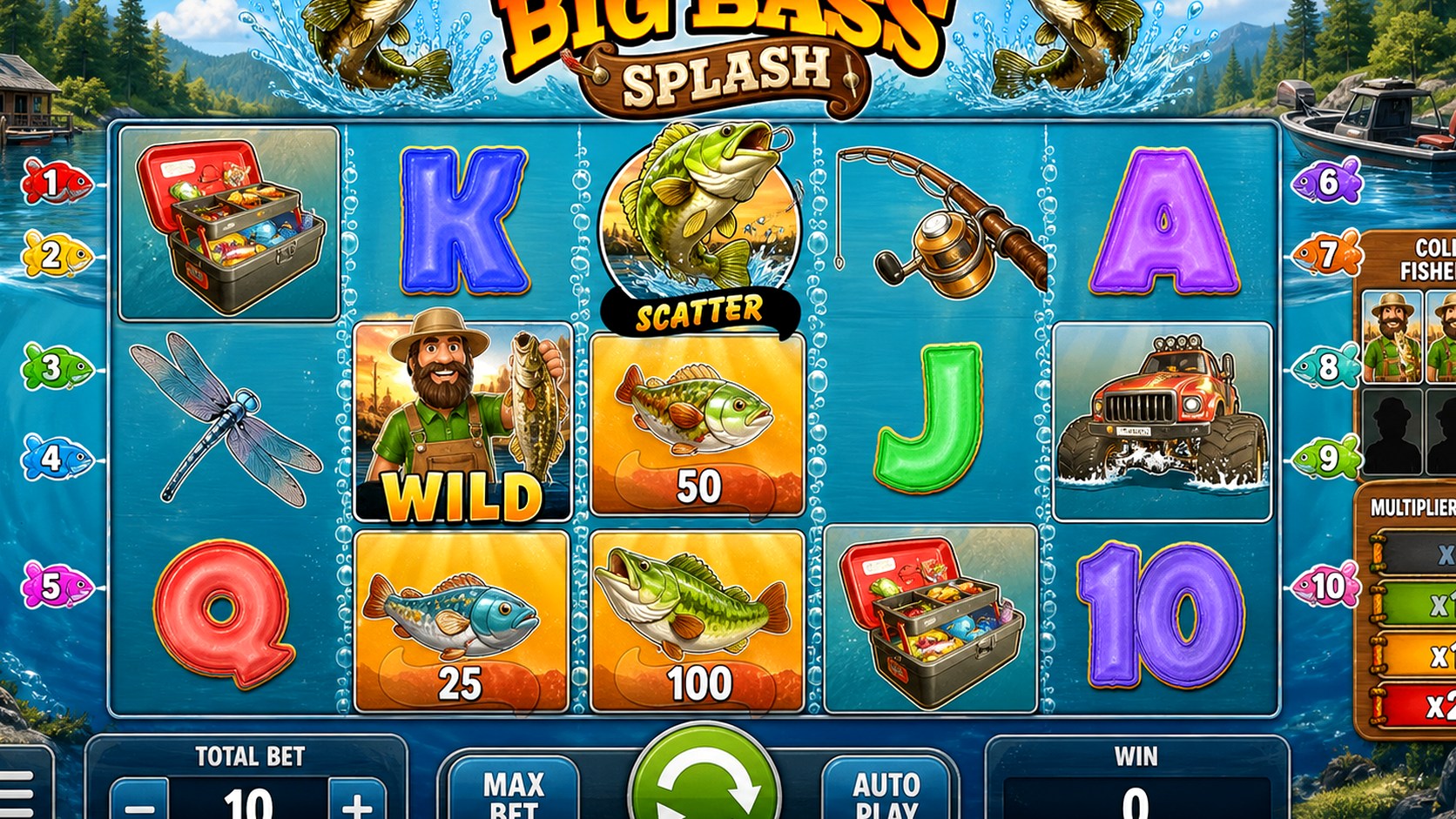
Por Fairy Editorial - 19 Aug 2026
Monopoly City Review: Building a Fortune One Roll at a Time
Monopoly City
Monopoly City Review: Building a Fortune One Roll at a Time

Monopoly City puts its premise on screen before the first paid action: A 160-pixel listing thumbnail confirms a cartoon city identity, but it is too small for publication and was used only as a visual clue. The visible theme gives the review a place to start, but it cannot fill gaps in the rule sheet. Public GG Soft catalogues identify Monopoly City as an arcade or board-style title rather than a conventional reel slot; two operator pages show conflicting return figures of 90 percent and 82 percent, and no functioning rules screen was available to resolve the discrepancy. Exact values from the active operator build take priority wherever public records are absent, contradictory or inaccessible. The three horizontal pictures are original editorial reconstructions. They avoid real-world board-game mascots, property names, token shapes and branded board design, and they do not claim to reproduce a live GG Soft round.

This review uses a narrow evidence hierarchy. A first-party help panel in the deployed game would rank first, followed by a studio product page, then a public lobby record and finally a secondary catalogue. A picture may confirm visual identity, while a text listing may identify a grid or published return. Neither should be stretched into a claim about feature frequency, reel strips, random-number generation or the exact configuration used by a different operator. No paid wager was made for this article. The attempted public clients did not reach a usable game session, so there is no spin diary, hit-rate sample or personal balance result to report. The screen analysis instead asks what a Philippine player should verify once the local build opens: accepted stake, settlement unit, history entry, rule version, return setting, volatility label, maximum-award denominator and any separate cash limit. That is a more dependable review method than inventing a lucky session. The reconstructed pictures are designed to keep the discussion concrete on a phone-sized landscape canvas. Their controls, symbol positions, counters and values are props. They do not certify a pay route and must not be presented later as proof that a feature triggered. Where public material gives a specific layout, the artwork follows that broad structure; where the record is silent, the composition remains openly hypothetical. Every cash statement should still be checked against the accepted-round record after the screen has finished counting and before another action clears the display.

The Skyline Before the First Roll

Monopoly City opens with quick city-building momentum. The original young city architect and dice, roads, apartments, shops, parks, construction lots and upgrade markers are not background ornaments; they form a visual hierarchy that tells the eye where to look before any rule has been read. The reel area sits inside that hierarchy, so symbols remain distinct from the scenery instead of dissolving into it.

That first reading matters on a phone. A slot may spend heavily on illustration and still fail if the stake, spin control or settled result is hard to locate. Here the strongest idea is not mere decoration. It is the way electric blue, civic green, violet and construction gold separates the game board, framing art and controls into layers.

What the Public Catalogue Establishes

Public GG Soft catalogues identify Monopoly City as an arcade or board-style title rather than a conventional reel slot; two operator pages show conflicting return figures of 90 percent and 82 percent, and no functioning rules screen was available to resolve the discrepancy. A 160-pixel listing thumbnail confirms a cartoon city identity, but it is too small for publication and was used only as a visual clue. This is the firm boundary of the evidence used here.

A catalogue image can establish identity and art direction. It cannot establish the exact RTP setting, volatility band, reel mathematics, bet limits or highest award in every operator build. Those facts belong to the information panel of the version actually loaded.

Why 90 and 82 Cannot Both Be Assumed

Two public operator pages attach different return figures to the same named title: 90 percent on one page and 82 percent on another. Neither was backed by a visible version identifier or first-party math sheet, so this article does not select the more appealing number.

That gap matters more in an arcade title because the cost unit may be a roll, a level entry or another action rather than a familiar total-spin stake. Read the active rules, version label and debit field together before calculating turnover.

City Is a System, Not a Payout Promise

City in the title describes the object being built. It does not establish a jackpot, multiplier or guaranteed progression value. A rising skyline can be a visual score while every accepted roll remains independent.

The useful questions are concrete: what does one roll cost, how many spaces the dice move, which tiles pay, when an upgrade changes settlement and if a level can end before all displayed tasks are complete.

Board Geography Before Slot Vocabulary

Public catalogues place Monopoly City with arcade and board games. That classification should stop a reviewer from automatically inventing five reels, paylines, Wilds and Scatters simply because the title appears in an online casino lobby.

The reconstruction uses an isometric route, city tiles and a dice control. It deliberately avoids a reel panel because public catalogues classify the title as an arcade or board game. The actual route length, movement rule and payment model need the local instructions.

Buildings, Roads and Dice as Game Objects

The important objects are dice, road squares, property tiles, build sites and upgrade markers. Each needs a written effect. A shop might pay immediately, add a persistent city value, unlock another roll or function only as decoration.

Read the unit next to every coin or multiplier. A number on a building can be a purchase cost, level target, award or collection total. The transaction history should show which interpretation affected the account.

Low-Value Tiles Still Consume a Roll

Small road and utility tiles may occupy much of the route. Their visual size does not reveal frequency or value. A quiet square can settle a modest credit, move the marker again or consume the action without payment.

Judge each roll by the debit and final credit. A level-up animation after a loss may still mark progress inside the city, but progress should not be confused with cash returned to the wallet.

Tracing Movement and Settlement

Follow the token from its starting square through every movement step. If a roll crosses or lands on several highlighted sites, the result panel should say which positions counted and if pass-over awards differ from landing awards.

When several city events resolve together, open history before the next roll. Building income, a tile prize, a double modifier and a task reward may appear as one total even though they arise from separate rules.

Wild Language May Not Belong Here

Wild is reel terminology and may have no role in Monopoly City. Do not label a flexible tile, substitute property or mystery square as Wild unless the client itself uses that word and defines what it replaces.

If a mystery object changes identity, record the available outcomes, timing and settlement scope. A transform animation does not automatically mean universal substitution.

Scatter Language May Not Belong Here Either

Scatter is also a reel term that may be irrelevant to this board model. A symbol placed in several locations can still be a collection item, property class or level objective rather than a Scatter.

Use the vocabulary printed by the game. Dice doubles, bonus squares, build icons and checkpoint tiles should each be described by their own rule instead of being forced into slot categories.

Reading a City Level Without Guessing

any city level, route or property meter shown by the client should state what causes progress, if it persists between paid rolls and what happens at the endpoint. A nearly complete skyline is not evidence that the next action has improved cash odds.

Refresh or reopen only after recording the state. If the city level survives, the manual should explain persistence and expiry. If it resets, it may be a one-round presentation rather than stored value.

The Basic Paid Roll

The basic paid action appears to be the roll, not a reel spin. Its cost, accepted state and settled result must stay visible. Animation of the marker moving through the city should not conceal when the account was debited.

Test at minimum value and wait until all buildings and counters stop. Then compare opening balance, action cost, credited amount and ending balance. The route animation is useful context; the ledger is the result.

What a Build or Upgrade Must Change

any build, upgrade or double-return action defined by the rules must change a documented rule. A build may raise tile value, unlock a district, add a roll or alter a later settlement. A taller building without a stated effect is only progression art.

Check duration and ownership. Some upgrades may last one level, one paid action or the full session. An operator account should not be assumed to retain a city permanently unless the rules state that persistence.

Double Return Needs a Defined Base

A visible 2x can multiply the tile award, all income in the current roll, a task bonus or the level total. Its position beside a button is not enough. The settlement message must attach it to a base value.

If dice doubles also grant a repeat roll, separate that action benefit from any cash multiplier. Extra movement and multiplied credit are different advantages and should not share one vague description.

Celebration Screens and Award Caps

City celebrations may fill the screen after a district is completed. The sequence does not reveal the largest legal award or any cash ceiling. A progression milestone can occur with a modest net return.

Calculate the ratio from the total accepted cost for the originating action. If a level contains several separately paid rolls, do not divide the final level award by only the last roll unless the rules explicitly group them.

Picture One: An Original City Reconstruction

The first picture translates the tiny catalogue clue into an original city-tycoon interface. It preserves only the broad green-blue mood and exact game name, not the mascot or design of any physical board-game brand.

The picture belongs to the visual review only. It must never be used as a substitute for a paytable, probability statement or operator-specific stake range.

Picture Two: Dice and Build Controls

The second picture tightens the view around roads, build sites, upgrade arrows and the dice control. These components make the evaluation concrete but are not GG Soft source assets.

Its job is to make phone layout, symbol hierarchy and control placement easier to discuss. The written rules remain the authority for every cash calculation.

Picture Three: The Upgrade Route

The third picture enlarges the imagined city route. Its coin meter, tiles and task panel are layout props, not a record of a paid roll or a statement of return.

A live history panel should show more than any promotional still: original stake, component awards, modifiers and final credit. That record is the correct place to audit settlement.

City audit 19: Sound Design and Perceived Pace

quick city-building momentum can be strengthened through layered music, reel-stop cues and short feature stingers. Sound is useful when it marks a trigger or completed calculation. It becomes less useful when every partial return receives the same fanfare as a clear profit.

Try several rounds with audio lowered. If the board still communicates outcome, the interface is doing its job. If the result becomes ambiguous without a voice line or long count-up, the visual feedback needs more attention. Audio should confirm settlement, not replace the numbers.

City audit 20: Landscape Play and Thumb Reach

A horizontal phone gives the isometric city board room on both sides of the reels. The central board remains large while settings, stake controls and spin can occupy the lower band. This arrangement works best when the largest button sits away from the minus and plus controls.

Before rapid play, rotate the device, enter full screen and check the total-stake field after one adjustment. Browser bars and system gestures can cover edge controls. A test spin at the minimum setting confirms that the hit boxes match the visible buttons and that no accidental Max Bet control sits beneath the thumb.

City audit 21: Portrait Mode Is a Compromise

Portrait layout may scale the entire game down or reorganize controls beneath the grid. Tiny payline markers and condensed help text are the first casualties. The screen can remain playable, yet accurate rule reading becomes harder when the table requires repeated zooming or horizontal swipes.

Use portrait mode for quick navigation, not for the first rules check. Landscape is the better place to compare total stake, balance and win because all three can remain visible together. The relationship between those numbers matters more than keeping the device in one hand.

City audit 22: Performance on Mid-Range Phones

The artwork uses multiple layers, large character cutouts and particle effects. On a mid-range handset, watch for delayed button response after a count-up, audio falling out of step with the reels or a stake change taking effect one round late. Those are interface problems, not signs of altered probability.

Close other heavy apps and use a stable connection during the first session. If the client reconnects, verify balance and the last completed round in history before spinning again. A frozen animation can recover after the server has already settled the result, so the account record takes priority over the last visible frame.

City audit 23: Stake Controls Deserve More Attention Than the Mascot

A growing skyline and short upgrade goals can turn each roll into a reason for one more paid action even when the account history shows no gain. The most useful habit is to read total stake after every change and before the first rapid sequence. Bet per line, coin value and total bet may occupy separate fields, and altering one can multiply the final debit.

A planned session should be written in money, spins and time. Divide the session amount by the intended number of paid rounds to find a workable average stake. Free actions do not add a new debit unless the client states a purchase. This arithmetic is dull, but it controls exposure more reliably than any theme-based hunch.

City audit 24: RTP Belongs to Turnover, Not a Short Run

Once the deployed RTP is known, interpret it as a long-run model ratio. If the help page lists 96 percent, theoretical cost is four units per hundred units of turnover. That sentence is an example of the calculation, not a claim that this version uses 96 percent.

Turnover equals total paid stake across accepted rounds. A hundred spins at one unit create one hundred units of turnover even if several free actions appear between them. A short session may finish far above or below the model ratio because random outcomes do not settle into a neat percentage on demand.

City audit 25: Volatility Is About Distribution

Volatility describes how payout value is spread across outcomes. A higher band usually places more weight in less common large results; a lower band usually returns more of its value through smaller payments. The label does not state when a feature will arrive or how long a losing sequence can last.

Without an official band, infer nothing from quick city-building momentum. A calm fruit village can use severe math, and a battlefield can use a mild distribution. After the label is found, use it to size stake and session length, not to forecast the next reel stop.

City audit 26: Maximum Win Needs a Denominator

A maximum written as 1000x or 5000x must say what x means. It may refer to total bet, coin value, feature stake or a base amount before an ante. Some clients also apply a fixed cash ceiling. The lower of the mathematical award and cash cap may be the amount actually credited.

Check if the cap ends the feature immediately or allows remaining actions to play without added credit. Also check if simultaneous line, Scatter and jackpot awards share one cap. A headline number without these conditions is incomplete and should never be used to set a spending target.

City audit 27: A Clean Demo Test in Thirty Paid Rounds

Use the minimum fixed stake and create one row for each paid round. Record starting balance, debit, base credit, feature credit, ending balance and any meter change. Keep free actions inside the row of the spin that triggered them. This format exposes the money flow without treating a tiny sample as statistical proof.

Thirty rounds are enough to learn button behavior, symbol settlement and feature messages. They are not enough to estimate RTP or trigger frequency. The purpose is mechanical literacy. Stop the test once each major control has been checked; more spins do not turn an informal sample into certification.

City audit 28: How to Audit a Bonus From Start to Finish

Capture the trigger screen, starting counter, carried stake and opening multiplier. Then note each retrigger, held symbol, expanding reel or meter reset. At the end, compare the feature total with the history record and final balance. Every free action should trace back to one paid round.

If a purchase button exists, treat it as a separate bet mode. Record its price as the full stake for that round and read its RTP entry independently if the client lists one. A purchased feature may use the same animation while carrying a different cost structure.

City audit 29: Common Misreads Around Monopoly City

The first misread is assuming that City states the unconditional top award. The second is assigning premium status solely from symbol size. The third is treating a filling any city level, route or property meter shown by the client as proof that a feature is due. The fourth is calling every substitute a multiplier Wild without checking the rules.

The fifth is copying an RTP from an unrelated review. The sixth is counting free actions as fresh paid spins. The seventh is judging profit from the win banner instead of balance movement. Each mistake disappears when the player keeps the stake field, history panel and help page in the same audit.

City audit 30: What Philippine Players Should Verify

A Philippine listing may use peso values, wallet credits or a converted coin display. Confirm the minimum and maximum total stake, not merely coin size. Check that the operator names GG Soft as the studio, and compare the logo with the official key art before assuming that a similarly named title is the same product.

Also read local rules for feature purchases, autoplay, session reminders and cash limits. These controls belong to the operator build and jurisdiction. A screenshot from another market can explain layout, but it cannot establish the available stake range or certified return in a Philippine account.

City audit 31: Who Gets the Most From This Theme

Readers who prefer dice, board movement and city upgrades to a standard spinning reel cabinet will find the presentation immediately legible. The theme also suits short review sessions because the visual hierarchy can be judged quickly. That does not make the mathematical profile suitable for every budget; the actual volatility and minimum total stake still control that decision.

Anyone who dislikes dense side art or loud event effects should test the sound and fast-play controls first. A strong theme can be a reason to open a demo, but it is not a reason to ignore the paytable. Interest in the artwork and comfort with the stake are separate choices.

City audit 32: A Practical Decision Checklist

Before real play, confirm the exact title, studio, RTP, volatility, win method, Wild exceptions, Scatter route, feature trigger, multiplier scope, maximum-win denominator and cash cap. Then set a total session amount and a stopping time. If any critical rule remains hidden, keep the title in demo mode.

During play, watch balance rather than animation. After play, compare opening balance, deposits, withdrawals and ending balance with the history log. This checklist does not change random results. It changes how clearly the cost and settlement can be seen.

City audit 33: Final Reading: Theme First, Math Before Money

Monopoly City should be judged as a paid arcade board before it is described with slot vocabulary. Its building loop is easy to picture; the conflicting public return figures and missing rule screen make the deployed client the only safe source for cost and settlement

Monopoly City earns attention through quick city-building momentum and a tightly coordinated electric blue, civic green, violet and construction gold palette. The next step is not a larger stake; it is the local information screen. Confirm the deployed math, test the controls at minimum value and treat every visual promise as a question that the rules must answer.

City audit 34: Separating Hit Rate From Profit Rate

A hit is any result the rules count as a payment. Profit requires the credited amount to exceed the full stake for that paid round. A title can register frequent small hits while the balance declines. Without an official hit-frequency figure, the only safe statement is that the two rates are not interchangeable.

For a demo log, mark return ratios below 1x, exactly 1x and above 1x in separate columns. This reveals how many recorded wins were partial returns. It still does not predict future play, but it gives a much clearer account of the sample than a simple count of flashing win messages.

City audit 35: Near Misses Are Animation, Not Progress

A bonus icon stopping just outside a payline or a premium symbol passing during reel motion can feel meaningful. Unless the written rule stores that event, it has no carry-over value. The next accepted round is not improved because the previous animation looked close.

The same caution applies to two trigger symbols when three are required. They may create suspense, yet their payment and stored effect depend entirely on the table. Record what was credited, then clear the image from the decision about the next stake.

City audit 36: Fast Play Changes Exposure Speed

Fast play shortens animation; it does not normally change the random model. Its financial effect comes from time. More paid rounds can fit into the same minute, so the balance may move faster even though the stake per round stays fixed.

Measure pace before enabling it. Ten ordinary rounds on standard speed and ten on fast speed reveal the difference in turnover per minute. If the faster rate breaks the planned session limit, lower the stake or return to standard timing rather than relying on attention alone.

City audit 37: Autoplay Needs Stop Conditions

Where autoplay is available, set a round count and use any loss, win or single-award limits shown by the client. Read those fields carefully because some are cash values while others are stake multipliers. An empty field may mean no automatic stop for that condition.

Remain present during automated rounds. Network reconnection, a feature choice or a changed balance can pause the sequence. Autoplay is a convenience control, not a budget system, and it does not make a long sample more likely to follow the theoretical return.

City audit 38: Responsible Play in Plain Numbers

Set a sum that can be lost without affecting bills, savings or debt payments. Do not borrow to play, do not chase a prior loss and do not treat a rare large result as income. Time reminders and deposit limits are useful because strong game art can blur the length of a session.

If play stops feeling optional, close the client and use the operator exclusion or limit tools. The clearest review of any slot ends with the same fact: outcomes are random, the house keeps a mathematical margin over long turnover and no visual pattern creates a reliable edge.
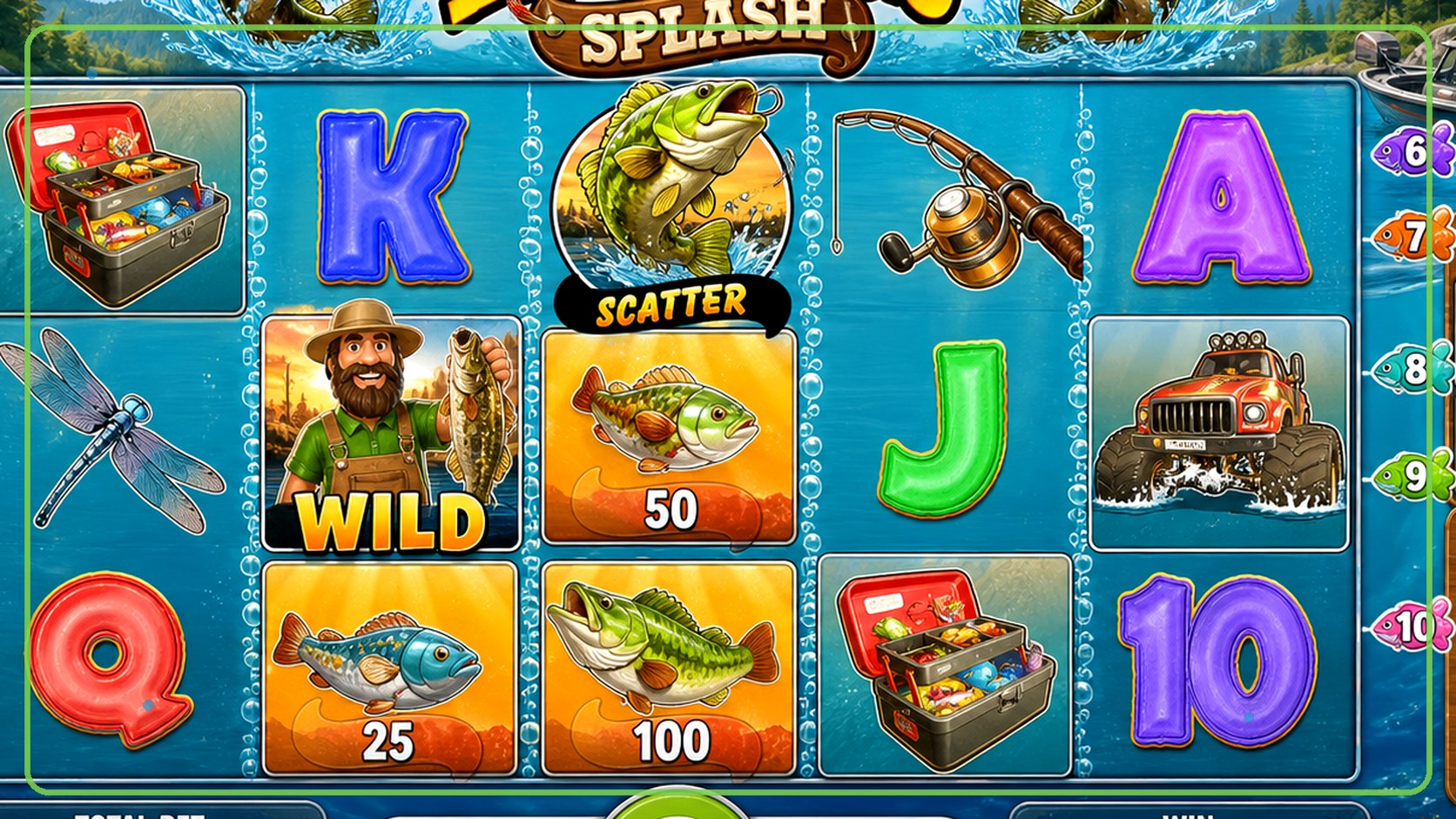
Por Fairy Editorial - 19 Aug 2026
Book of the Fallen Review: Ten Free Spins and One Very Expensive Switch
Livro dos Caídos
Book of the Fallen Review: Ten Free Spins and One Very Expensive Switch

Book of the Fallen puts its central idea on screen before the first paid action. The official demo component loaded behind an 18-plus confirmation layer, which this review did not click. That gives the review a clear starting point without turning inaccessible details into guesses. Pragmatic Play publicly describes Book of the Fallen as a 3 by 5 Egyptian slot with the Eye of Anubis book acting as both Wild and Scatter, three books awarding ten free spins, a 96.50 percent return and a Super Spins Ante option priced at ten times the current total stake per spin. The operator help panel still takes priority for regional stake ranges, return variants and cash limits. The three horizontal pictures are editorial reconstructions guided by the official public description. They are not Pragmatic Play screenshots or evidence that three books landed in a tested round. This article follows a strict evidence order. A live help panel in the deployed client would rank first, followed by a studio product page, an operator listing and then a secondary directory. Artwork can establish identity and theme; it cannot certify reel strips, probabilities, feature frequency or a regional return setting. Any figure lacking a visible first-party rule is identified as secondary rather than repeated as fact. No paid wager was placed. The available demo components remained behind age or security layers, so there is no personal spin sample, balance result or claimed hit rate. The review instead maps each published mechanism to a check that can be completed once the Philippine build opens: stake debit, settlement unit, history entry, return configuration, volatility label, maximum-award denominator and cash ceiling. The reconstructed pictures keep the analysis concrete on a landscape phone canvas. Their controls, symbols, counters and values are props. They should never be reused as proof that a bonus triggered or a particular award occurred. Where the studio publishes a grid, the art follows its broad shape; where the record is silent, the layout is openly hypothetical.

Entering the Sealed Chamber

Book of the Fallen opens with measured tomb exploration. The rugged tomb explorer and Anubis masks, pharaohs, ankhs, scarabs, compasses, card ranks and the Eye of Anubis book are not background ornaments; they form a visual hierarchy that tells the eye where to look before any rule has been read. The reel area sits inside that hierarchy, so symbols remain distinct from the scenery instead of dissolving into it.

That first reading matters on a phone. A slot may spend heavily on illustration and still fail if the stake, spin control or settled result is hard to locate. Here the strongest idea is not mere decoration. It is the way sandstone amber, lapis blue, turquoise and polished gold separates the game board, framing art and controls into layers.

What Pragmatic Play States

Pragmatic Play publicly describes Book of the Fallen as a 3 by 5 Egyptian slot with the Eye of Anubis book acting as both Wild and Scatter, three books awarding ten free spins, a 96.50 percent return and a Super Spins Ante option priced at ten times the current total stake per spin. The official demo component loaded behind an 18-plus confirmation layer, which this review did not click. This is the firm boundary of the evidence used here.

A catalogue image can establish identity and art direction. It cannot establish the exact RTP setting, volatility band, reel mathematics, bet limits or highest award in every operator build. Those facts belong to the information panel of the version actually loaded.

Reading the Published 96.50 Percent

Pragmatic Play prints 96.50 percent on the public game page. Use that as the catalogue setting, then verify the operator build because alternate certified returns can share the same title and art.

The Super Spins Ante changes cost by a factor of ten. Even if its return percentage is close to the base mode, turnover per accepted action becomes ten times larger at the same displayed base selection.

The Book Has Two Jobs

The word Book is the headline hook. It raises an obvious question: does it describe a multiplier, a progression, a visual motif or simply the scale of the story? Only the help screen can answer that. A number or power word in a logo is not automatically the highest cash ratio for a paid round.

Before treating the title as a promise, locate the line that defines it. Check the triggering symbols, the stage at which the value applies, any stake multiplier, the cap on simultaneous wins and any separate cash ceiling. If those conditions are absent, the name should remain a marketing label rather than a calculation.

Five Reels and Three Rows

The studio calls the board 3 by 5, conventionally five reels and three rows. A secondary catalogue lists ten paylines. The local paytable should show each route and confirm that combinations run from the first reel.

The reconstruction follows the official 3 by 5 statement. A secondary catalogue describes ten lines, but the deployed paytable should confirm the exact routes, direction and If the Super Spins state uses the same line structure.

Anubis, Pharaoh and Explorer Symbols

The theme naturally divides the reel set into character or object symbols, special icons and ornate card ranks. Anubis masks, pharaohs, ankhs, scarabs, compasses, card ranks and the Eye of Anubis book carry more visual weight than the letters and numbers. That weight usually signals premium status, but the paytable may rank two similar objects very differently. Size and shine are clues, never final values.

Read every payout in the unit used by the game. Some tables show bet-per-line units; others use total stake. A five-of-a-kind figure can appear ten or twenty times larger if the unit is misunderstood. The cash meter after a test spin is useful, but the written help panel should settle the conversion.

Why the Card Ranks Still Matter

ornate card ranks occupy a large share of ordinary reel time in the editorial layout. They create visual breathing room around the premium art and make small combinations quick to recognize. Their role in the mathematical model may be larger than their small paytable values suggest because frequency and value are separate parts of return.

A low-symbol hit can light the grid while returning less than the amount staked. That is a paid result, not necessarily a profitable round. The correct comparison is final credit divided by the full spin cost. Animation length, coin count and sound volume do not change that ratio.

Following One of the Ten Routes

Large portraits and objects such as Anubis masks, pharaohs, ankhs, scarabs, compasses, card ranks and the Eye of Anubis book can dominate the frame. The practical test is to follow one settled combination from its first symbol to its last without relying on flashing borders. Clear spacing between reels, consistent icon silhouettes and a visible route make the result easier to audit.

If several awards arrive together, open the win breakdown or history panel. One total may contain multiple lines, an anywhere payment and a modifier. Treating the largest symbol on screen as the sole cause can produce a false reading of the rule, especially when a substitute or multiplier is also present.

The Book as Wild

The Eye of Anubis book is officially a Wild as well as a Scatter. In its Wild role, the manual should state which symbols it replaces and if a book combination has its own pay.

Do not let the Scatter role erase the substitution question. One symbol can trigger a feature and still complete an ordinary payline under separate rules.

The Book as Scatter

Three books trigger ten free spins according to the studio page. Record their reel positions and the starting counter, then check if extra books add spins or increase only a Scatter payment.

Because the book is also Wild, a three-book screen may contain a line award and a feature trigger. History should separate those components.

Ten Free Spins on the Counter

free-spin counter and Super Spins Ante switch should be treated as an interface question, not a prediction. If the deployed client displays it, the help page must say what moves it, when it resets and if any progress survives the next paid round.

Watch one complete cycle before assigning meaning. A circle, gauge or counter may show collected symbols, a one-round modifier, a bonus threshold or only decorative state. A nearly full graphic does not prove that a feature is due.

The Base Tomb Before the Switch

Many reviews rush past the paid reels and treat the bonus as the only meaningful part. That misses the money path. Base spins create nearly all turnover, settle small and medium awards, and decide how long a balance remains available. A rare feature cannot repair a stake level that is too high for the intended session.

Book of the Fallen needs ordinary results that are readable at a glance. A clean board lets the user distinguish a no-win, a partial return and a profit without waiting for a long count-up. That clarity is especially important when the surrounding torchlit Egyptian burial chamber is busy and the screen uses strong motion.

Super Spins at Ten Times Cost

Ten natural free spins begin without another debit after the triggering base round. Super Spins takes another route: every activated spin costs ten times the current total and plays like the feature state.

That description makes Super Spins a repeated premium bet, not a one-time ten-times purchase for ten actions. Confirm the debit on one minimum-value test before any sequence.

Where Any Feature Multiplier Applies

A multiplier can act on one symbol, one line, the current cascade, all wins in a free-spin round or the final feature total. Saying that a game has multipliers leaves the crucial calculation unanswered. The placement of the number and the wording of the win message usually reveal the scope.

Also check if several multipliers add or multiply together. Two visible 2x values could mean 4x, a combined 4x through addition, or separate modifiers on different awards. The history entry after settlement is the safest way to test. Never extrapolate the top result from a promotional badge alone.

A Secondary 5000x Claim Needs Local Proof

Clients often label results with tiers such as big, mega or super. Those labels are commonly based on the ratio between win and current stake. They do not prove that the result reached the mathematical ceiling. The count-up may also stop at a cash cap even when the theoretical symbol total is higher.

To calculate a genuine ratio, divide the credited result by the total stake removed for the paid round. Include free follow-up actions inside that same round unless the rules state otherwise. This method turns a loud presentation into a comparable number and avoids confusing coins on screen with peso value.

Picture One: Egyptian Reconstruction

The first picture turns the official Egyptian brief into a wide review screen with an original explorer and a five-by-three board. It does not copy a live balance or recorded outcome.

The picture belongs to the visual review only. It must never be used as a substitute for a paytable, probability statement or operator-specific stake range.

Picture Two: The Five-by-Three Board

The second picture brings Anubis, pharaoh, ankh, scarab, compass and card ranks forward so symbol hierarchy can be discussed without treating size as value.

Its job is to make phone layout, symbol hierarchy and control placement easier to discuss. The written rules remain the authority for every cash calculation.

Picture Three: Books and Ante Switch

The third picture concentrates on three Eye of Anubis books, the ten-free-spin note and the ten-times Ante switch. Those labels explain the published paths but do not document a trigger.

A live history panel should show more than any promotional still: original stake, component awards, modifiers and final credit. That record is the correct place to audit settlement.

Tomb ledger 19: Sound Design and Perceived Pace

measured tomb exploration can be strengthened through layered music, reel-stop cues and short feature stingers. Sound is useful when it marks a trigger or completed calculation. It becomes less useful when every partial return receives the same fanfare as a clear profit.

Try several rounds with audio lowered. If the board still communicates outcome, the interface is doing its job. If the result becomes ambiguous without a voice line or long count-up, the visual feedback needs more attention. Audio should confirm settlement, not replace the numbers.

Tomb ledger 20: Landscape Play and Thumb Reach

A horizontal phone gives the torchlit Egyptian burial chamber room on both sides of the reels. The central board remains large while settings, stake controls and spin can occupy the lower band. This arrangement works best when the largest button sits away from the minus and plus controls.

Before rapid play, rotate the device, enter full screen and check the total-stake field after one adjustment. Browser bars and system gestures can cover edge controls. A test spin at the minimum setting confirms that the hit boxes match the visible buttons and that no accidental Max Bet control sits beneath the thumb.

Tomb ledger 21: Portrait Mode Is a Compromise

Portrait layout may scale the entire game down or reorganize controls beneath the grid. Tiny payline markers and condensed help text are the first casualties. The screen can remain playable, yet accurate rule reading becomes harder when the table requires repeated zooming or horizontal swipes.

Use portrait mode for quick navigation, not for the first rules check. Landscape is the better place to compare total stake, balance and win because all three can remain visible together. The relationship between those numbers matters more than keeping the device in one hand.

Tomb ledger 22: Performance on Mid-Range Phones

The artwork uses multiple layers, large character cutouts and particle effects. On a mid-range handset, watch for delayed button response after a count-up, audio falling out of step with the reels or a stake change taking effect one round late. Those are interface problems, not signs of altered probability.

Close other heavy apps and use a stable connection during the first session. If the client reconnects, verify balance and the last completed round in history before spinning again. A frozen animation can recover after the server has already settled the result, so the account record takes priority over the last visible frame.

Tomb ledger 23: Stake Controls Deserve More Attention Than the Mascot

The ten-times Ante price makes a short sequence consume turnover far faster than the base stake field suggests if the multiplier is overlooked. The most useful habit is to read total stake after every change and before the first rapid sequence. Bet per line, coin value and total bet may occupy separate fields, and altering one can multiply the final debit.

A planned session should be written in money, spins and time. Divide the session amount by the intended number of paid rounds to find a workable average stake. Free actions do not add a new debit unless the client states a purchase. This arithmetic is dull, but it controls exposure more reliably than any theme-based hunch.

Tomb ledger 24: RTP Belongs to Turnover, Not a Short Run

Once the deployed RTP is known, interpret it as a long-run model ratio. If the help page lists 96 percent, theoretical cost is four units per hundred units of turnover. That sentence is an example of the calculation, not a claim that this version uses 96 percent.

Turnover equals total paid stake across accepted rounds. A hundred spins at one unit create one hundred units of turnover even if several free actions appear between them. A short session may finish far above or below the model ratio because random outcomes do not settle into a neat percentage on demand.

Tomb ledger 25: Volatility Is About Distribution

Volatility describes how payout value is spread across outcomes. A higher band usually places more weight in less common large results; a lower band usually returns more of its value through smaller payments. The label does not state when a feature will arrive or how long a losing sequence can last.

Without an official band, infer nothing from measured tomb exploration. A calm fruit village can use severe math, and a battlefield can use a mild distribution. After the label is found, use it to size stake and session length, not to forecast the next reel stop.

Tomb ledger 26: Maximum Win Needs a Denominator

Secondary catalogues commonly list a 5000x maximum. The public studio description opened for this review did not place that figure beside the visible rules, so the active client must confirm it.

The denominator should be total stake for the accepted round, including the ten-times Super Spins price where applicable. A fixed cash cap may reduce the credited amount.

Tomb ledger 27: A Clean Demo Test in Thirty Paid Rounds

Use the minimum fixed stake and create one row for each paid round. Record starting balance, debit, base credit, feature credit, ending balance and any meter change. Keep free actions inside the row of the spin that triggered them. This format exposes the money flow without treating a tiny sample as statistical proof.

Thirty rounds are enough to learn button behavior, symbol settlement and feature messages. They are not enough to estimate RTP or trigger frequency. The purpose is mechanical literacy. Stop the test once each major control has been checked; more spins do not turn an informal sample into certification.

Tomb ledger 28: How to Audit a Bonus From Start to Finish

Capture the trigger screen, starting counter, carried stake and opening multiplier. Then note each retrigger, held symbol, expanding reel or meter reset. At the end, compare the feature total with the history record and final balance. Every free action should trace back to one paid round.

If a purchase button exists, treat it as a separate bet mode. Record its price as the full stake for that round and read its RTP entry independently if the client lists one. A purchased feature may use the same animation while carrying a different cost structure.

Tomb ledger 29: Common Misreads Around Book of the Fallen

The first misread is assuming that Book states the unconditional top award. The second is assigning premium status solely from symbol size. The third is treating a filling free-spin counter and Super Spins Ante switch as proof that a feature is due. The fourth is calling every substitute a multiplier Wild without checking the rules.

The fifth is copying an RTP from an unrelated review. The sixth is counting free actions as fresh paid spins. The seventh is judging profit from the win banner instead of balance movement. Each mistake disappears when the player keeps the stake field, history panel and help page in the same audit.

Tomb ledger 30: What Philippine Players Should Verify

A Philippine listing may use peso values, wallet credits or a converted coin display. Confirm the minimum and maximum total stake, not merely coin size. Check that the operator names Pragmatic Play as the studio, and compare the logo with the official key art before assuming that a similarly named title is the same product.

Also read local rules for feature purchases, autoplay, session reminders and cash limits. These controls belong to the operator build and jurisdiction. A screenshot from another market can explain layout, but it cannot establish the available stake range or certified return in a Philippine account.

Tomb ledger 31: Who Gets the Most From This Theme

Readers who know book-style Egyptian slots and want a close reading of the unusually costly Super Spins Ante route will find the presentation immediately legible. The theme also suits short review sessions because the visual hierarchy can be judged quickly. That does not make the mathematical profile suitable for every budget; the actual volatility and minimum total stake still control that decision.

Anyone who dislikes dense side art or loud event effects should test the sound and fast-play controls first. A strong theme can be a reason to open a demo, but it is not a reason to ignore the paytable. Interest in the artwork and comfort with the stake are separate choices.

Tomb ledger 32: A Practical Decision Checklist

Before real play, confirm the exact title, studio, RTP, volatility, win method, Wild exceptions, Scatter route, feature trigger, multiplier scope, maximum-win denominator and cash cap. Then set a total session amount and a stopping time. If any critical rule remains hidden, keep the title in demo mode.

During play, watch balance rather than animation. After play, compare opening balance, deposits, withdrawals and ending balance with the history log. This checklist does not change random results. It changes how clearly the cost and settlement can be seen.

Tomb ledger 33: Final Reading: Theme First, Math Before Money

Book of the Fallen is mechanically direct: five by three, a dual-purpose book, ten free spins and a ten-times Super Spins choice. The expensive alternate mode is the real review subject because its cost changes the meaning of every result shown after the switch

Book of the Fallen earns attention through measured tomb exploration and a tightly coordinated sandstone amber, lapis blue, turquoise and polished gold palette. The next step is not a larger stake; it is the local information screen. Confirm the deployed math, test the controls at minimum value and treat every visual promise as a question that the rules must answer.

Tomb ledger 34: Separating Hit Rate From Profit Rate

A hit is any result the rules count as a payment. Profit requires the credited amount to exceed the full stake for that paid round. A title can register frequent small hits while the balance declines. Without an official hit-frequency figure, the only safe statement is that the two rates are not interchangeable.

For a demo log, mark return ratios below 1x, exactly 1x and above 1x in separate columns. This reveals how many recorded wins were partial returns. It still does not predict future play, but it gives a much clearer account of the sample than a simple count of flashing win messages.

Tomb ledger 35: Near Misses Are Animation, Not Progress

A bonus icon stopping just outside a payline or a premium symbol passing during reel motion can feel meaningful. Unless the written rule stores that event, it has no carry-over value. The next accepted round is not improved because the previous animation looked close.

The same caution applies to two trigger symbols when three are required. They may create suspense, yet their payment and stored effect depend entirely on the table. Record what was credited, then clear the image from the decision about the next stake.

Tomb ledger 36: Fast Play Changes Exposure Speed

Fast play shortens animation; it does not normally change the random model. Its financial effect comes from time. More paid rounds can fit into the same minute, so the balance may move faster even though the stake per round stays fixed.

Measure pace before enabling it. Ten ordinary rounds on standard speed and ten on fast speed reveal the difference in turnover per minute. If the faster rate breaks the planned session limit, lower the stake or return to standard timing rather than relying on attention alone.

Tomb ledger 37: Autoplay Needs Stop Conditions

Where autoplay is available, set a round count and use any loss, win or single-award limits shown by the client. Read those fields carefully because some are cash values while others are stake multipliers. An empty field may mean no automatic stop for that condition.

Remain present during automated rounds. Network reconnection, a feature choice or a changed balance can pause the sequence. Autoplay is a convenience control, not a budget system, and it does not make a long sample more likely to follow the theoretical return.

Tomb ledger 38: Responsible Play in Plain Numbers

Set a sum that can be lost without affecting bills, savings or debt payments. Do not borrow to play, do not chase a prior loss and do not treat a rare large result as income. Time reminders and deposit limits are useful because strong game art can blur the length of a session.

If play stops feeling optional, close the client and use the operator exclusion or limit tools. The clearest review of any slot ends with the same fact: outcomes are random, the house keeps a mathematical margin over long turnover and no visual pattern creates a reliable edge.
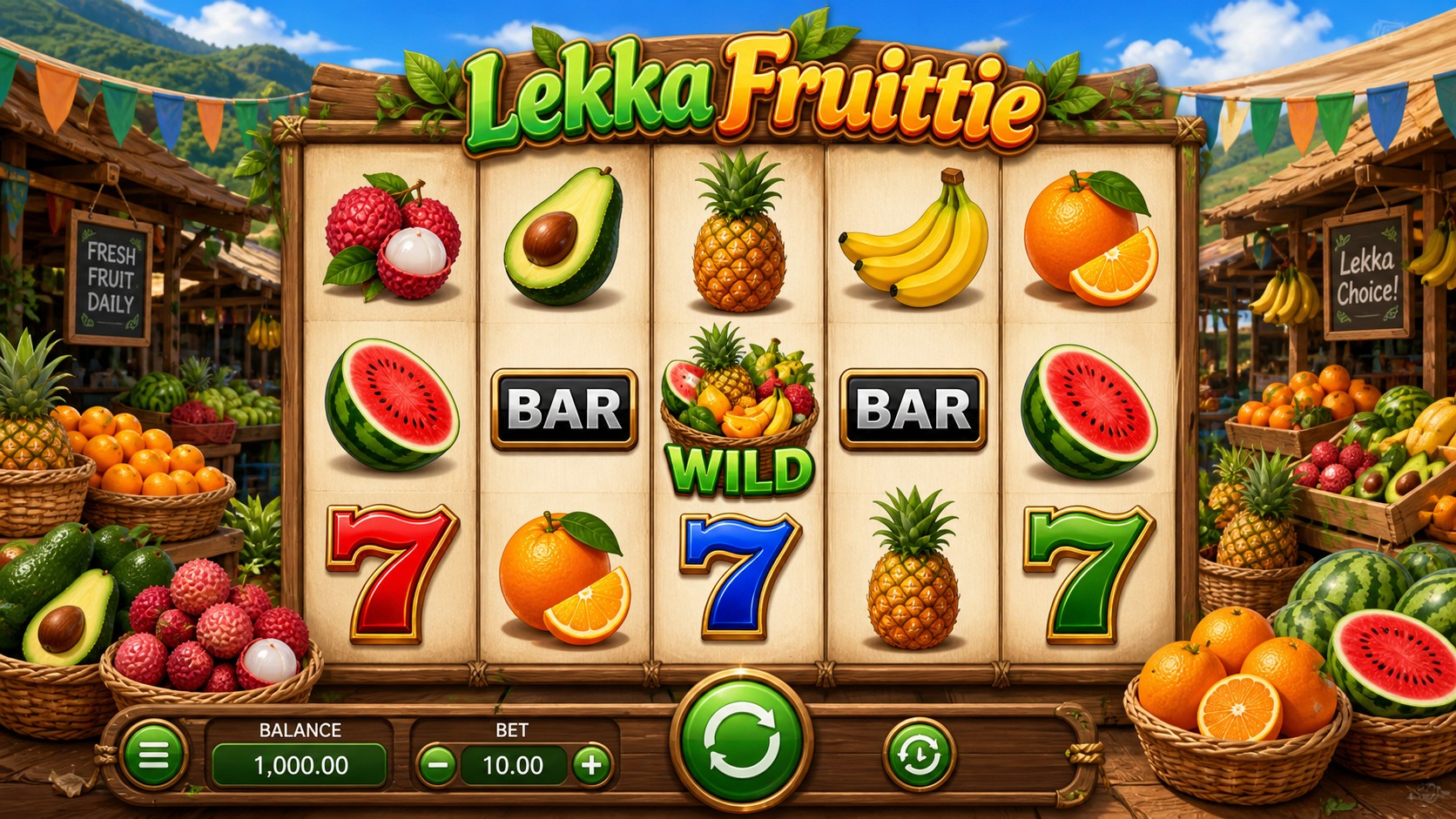
Por Fairy Editorial - 19 Aug 2026
Toilet Empire Review: Royal Plumbing, Comic Reels and a Necessary Fact Check
Império do Banheiro
Toilet Empire Review: Royal Plumbing, Comic Reels and a Necessary Fact Check

Toilet Empire has a title built to provoke curiosity. The article art is a tasteful comic reconstruction built from the title rather than a captured game client. Because reliable first-party game material was not available, this review separates visual interpretation from factual rule claims at every step. No trustworthy public AIS Gaming product page or working demo for this exact title was available during this check. Exact RTP, volatility, win method, bonus frequency and maximum award therefore stay on the verification list unless the deployed help page states them. All three pictures are editorial reconstructions based on the exact title and named studio. They are not AIS Gaming screenshots, certified mechanics or records of a live balance.

Arrival at the Royal Washroom

Toilet Empire opens with clean absurdist luxury. The uniformed palace attendant and golden toilets, plungers, paper rolls, soap, water gems, crowns and brass pipes are not background ornaments; they form a visual hierarchy that tells the eye where to look before any rule has been read. The reel area sits inside that hierarchy, so symbols remain distinct from the scenery instead of dissolving into it.

That first reading matters on a phone. A slot may spend heavily on illustration and still fail if the stake, spin control or settled result is hard to locate. Here the strongest idea is not mere decoration. It is the way royal blue, porcelain white, polished brass and jewel purple separates the game board, framing art and controls into layers.

What the Public Record Does Not Show

No trustworthy public AIS Gaming product page or working demo for this exact title was available during this check. The article art is a tasteful comic reconstruction built from the title rather than a captured game client. This is the firm boundary of the evidence used here.

A catalogue image can establish identity and art direction. It cannot establish the exact RTP setting, volatility band, reel mathematics, bet limits or highest award in every operator build. Those facts belong to the information panel of the version actually loaded.

No Made-Up Percentage on the Work Order

No exact RTP is printed here because a first-party mathematical sheet for the deployed Philippine build was not available for direct inspection. Repeating a familiar percentage from another site would turn an information gap into false precision.

The same restraint applies to volatility, hit frequency, bonus frequency and maximum win. A secondary directory may list figures, but the running help page and operator rules take priority because certified configurations and regional limits can differ.

What Empire Must Mean in the Manual

The word Empire is the headline hook. It raises an obvious question: does it describe a multiplier, a progression, a visual motif or simply the scale of the story? Only the help screen can answer that. A number or power word in a logo is not automatically the highest cash ratio for a paid round.

Before treating the title as a promise, locate the line that defines it. Check the triggering symbols, the stage at which the value applies, any stake multiplier, the cap on simultaneous wins and any separate cash ceiling. If those conditions are absent, the name should remain a marketing label rather than a calculation.

Measure the Reel Cabinet First

Start with the shape of the board and the rule used to recognize a result. A wide image can represent fixed paylines, adjacent ways, clusters, symbol counts or another method. The visible columns alone do not answer the question.

The reconstructed art uses a five-reel panel as a readable review device. The real product may use another grid, bet system or feature structure, and those details must come from its own help screen.

Fixture List and Symbol Hierarchy

The theme naturally divides the reel set into character or object symbols, special icons and compact royal emblems. golden toilets, plungers, paper rolls, soap, water gems, crowns and brass pipes carry more visual weight than the letters and numbers. That weight usually signals premium status, but the paytable may rank two similar objects very differently. Size and shine are clues, never final values.

Read every payout in the unit used by the game. Some tables show bet-per-line units; others use total stake. A five-of-a-kind figure can appear ten or twenty times larger if the unit is misunderstood. The cash meter after a test spin is useful, but the written help panel should settle the conversion.

Small Emblems Still Affect the Bill

compact royal emblems occupy a large share of ordinary reel time in the editorial layout. They create visual breathing room around the premium art and make small combinations quick to recognize. Their role in the mathematical model may be larger than their small paytable values suggest because frequency and value are separate parts of return.

A low-symbol hit can light the grid while returning less than the amount staked. That is a paid result, not necessarily a profitable round. The correct comparison is final credit divided by the full spin cost. Animation length, coin count and sound volume do not change that ratio.

Can the Pay Route Pass Inspection

Large portraits and objects such as golden toilets, plungers, paper rolls, soap, water gems, crowns and brass pipes can dominate the frame. The practical test is to follow one settled combination from its first symbol to its last without relying on flashing borders. Clear spacing between reels, consistent icon silhouettes and a visible route make the result easier to audit.

If several awards arrive together, open the win breakdown or history panel. One total may contain multiple lines, an anywhere payment and a modifier. Treating the largest symbol on screen as the sole cause can produce a false reading of the rule, especially when a substitute or multiplier is also present.

A Wild Needs a Written Specification

A Wild description is incomplete until three points are known: which symbols it copies, where it can land and if it carries its own value or multiplier. It may exclude Scatters, bonus icons or jackpots. Some Wilds expand or stay in place; others do nothing beyond substitution. The artwork cannot settle those exceptions.

When a Wild appears, compare the marked winning path with the natural symbols around it. Then check if the game pays the best valid combination or adds a separate Wild award. This small audit prevents a common error in which every decorated emblem is assumed to copy everything on the board.

Scatter Placement Is a Plumbing Diagram

A Scatter generally counts across specified reels or anywhere on the grid, but the required count and eligible positions vary. Three matching icons might start a feature in one version and merely pay in another. Some titles require the first, third and fifth reels; others accept any three positions.

Record the full trigger screen before naming the rule. Count the symbols, note their reels and wait for the award message. If the next screen changes mode, check the starting counter and carried stake. One observed trigger explains a route; it does not estimate how often that route will happen.

A Gauge Is Not Stored Pressure

possible service counter should be treated as an interface question, not a prediction. If the deployed client displays it, the help page must say what moves it, when it resets and if any progress survives the next paid round.

Watch one complete cycle before assigning meaning. A circle, gauge or counter may show collected symbols, a one-round modifier, a bonus threshold or only decorative state. A nearly full graphic does not prove that a feature is due.

Base Spins Are the Main Water Line

Many reviews rush past the paid reels and treat the bonus as the only meaningful part. That misses the money path. Base spins create nearly all turnover, settle small and medium awards, and decide how long a balance remains available. A rare feature cannot repair a stake level that is too high for the intended session.

Toilet Empire needs ordinary results that are readable at a glance. A clean board lets the user distinguish a no-win, a partial return and a profit without waiting for a long count-up. That clarity is especially important when the surrounding marble royal washroom is busy and the screen uses strong motion.

A Throne Mode Must Change the Mechanism

any throne or plumbing mode named by the client earns a separate name only if it changes a rule. It might alter the grid, symbol set, multiplier scope, number of actions or settlement method. A new background and louder sound are presentation changes, not new math.

Compare the help text before and after the mode begins. Record any carried stake, starting counter, retrigger condition and cap. If none of these elements changes, describe the event as an animation state rather than a distinct bonus mechanism.

Where the Multiplier Connects

A multiplier can act on one symbol, one line, the current cascade, all wins in a free-spin round or the final feature total. Saying that a game has multipliers leaves the crucial calculation unanswered. The placement of the number and the wording of the win message usually reveal the scope.

Also check if several multipliers add or multiply together. Two visible 2x values could mean 4x, a combined 4x through addition, or separate modifiers on different awards. The history entry after settlement is the safest way to test. Never extrapolate the top result from a promotional badge alone.

A Big Flush Animation Is Not the Cap

Clients often label results with tiers such as big, mega or super. Those labels are commonly based on the ratio between win and current stake. They do not prove that the result reached the mathematical ceiling. The count-up may also stop at a cash cap even when the theoretical symbol total is higher.

To calculate a genuine ratio, divide the credited result by the total stake removed for the paid round. Include free follow-up actions inside that same round unless the rules state otherwise. This method turns a loud presentation into a comparable number and avoids confusing coins on screen with peso value.

Picture One: The Concept Drawing

The first picture is a wide concept image made because no reliable official cover was located. It turns the title into a tasteful royal washroom without presenting invented rules as fact.

The picture belongs to the visual review only. It must never be used as a substitute for a paytable, probability statement or operator-specific stake range.

Picture Two: The Interface Blueprint

The second picture shows the full imagined interface with a five-reel panel and lower control bar. Those controls, symbols and values exist only to make the layout discussion visible.

Its job is to make phone layout, symbol hierarchy and control placement easier to discuss. The written rules remain the authority for every cash calculation.

Picture Three: Fixture Close-Up

The third picture moves closer to the crown, water gem, soap, paper and plunger symbols. It is a symbol-legibility study, not proof of a feature, win line or payout.

A live history panel should show more than any promotional still: original stake, component awards, modifiers and final credit. That record is the correct place to audit settlement.

Inspection point 19: Sound Design and Perceived Pace

clean absurdist luxury can be strengthened through layered music, reel-stop cues and short feature stingers. Sound is useful when it marks a trigger or completed calculation. It becomes less useful when every partial return receives the same fanfare as a clear profit.

Try several rounds with audio lowered. If the board still communicates outcome, the interface is doing its job. If the result becomes ambiguous without a voice line or long count-up, the visual feedback needs more attention. Audio should confirm settlement, not replace the numbers.

Inspection point 20: Landscape Play and Thumb Reach

A horizontal phone gives the marble royal washroom room on both sides of the reels. The central board remains large while settings, stake controls and spin can occupy the lower band. This arrangement works best when the largest button sits away from the minus and plus controls.

Before rapid play, rotate the device, enter full screen and check the total-stake field after one adjustment. Browser bars and system gestures can cover edge controls. A test spin at the minimum setting confirms that the hit boxes match the visible buttons and that no accidental Max Bet control sits beneath the thumb.

Inspection point 21: Portrait Mode Is a Compromise

Portrait layout may scale the entire game down or reorganize controls beneath the grid. Tiny payline markers and condensed help text are the first casualties. The screen can remain playable, yet accurate rule reading becomes harder when the table requires repeated zooming or horizontal swipes.

Use portrait mode for quick navigation, not for the first rules check. Landscape is the better place to compare total stake, balance and win because all three can remain visible together. The relationship between those numbers matters more than keeping the device in one hand.

Inspection point 22: Performance on Mid-Range Phones

The artwork uses multiple layers, large character cutouts and particle effects. On a mid-range handset, watch for delayed button response after a count-up, audio falling out of step with the reels or a stake change taking effect one round late. Those are interface problems, not signs of altered probability.

Close other heavy apps and use a stable connection during the first session. If the client reconnects, verify balance and the last completed round in history before spinning again. A frozen animation can recover after the server has already settled the result, so the account record takes priority over the last visible frame.

Inspection point 23: Stake Controls Deserve More Attention Than the Mascot

The joke is memorable enough to dominate attention, which makes the ordinary accounting of stake and return easier to neglect. The most useful habit is to read total stake after every change and before the first rapid sequence. Bet per line, coin value and total bet may occupy separate fields, and altering one can multiply the final debit.

A planned session should be written in money, spins and time. Divide the session amount by the intended number of paid rounds to find a workable average stake. Free actions do not add a new debit unless the client states a purchase. This arithmetic is dull, but it controls exposure more reliably than any theme-based hunch.

Inspection point 24: RTP Belongs to Turnover, Not a Short Run

Once the deployed RTP is known, interpret it as a long-run model ratio. If the help page lists 96 percent, theoretical cost is four units per hundred units of turnover. That sentence is an example of the calculation, not a claim that this version uses 96 percent.

Turnover equals total paid stake across accepted rounds. A hundred spins at one unit create one hundred units of turnover even if several free actions appear between them. A short session may finish far above or below the model ratio because random outcomes do not settle into a neat percentage on demand.

Inspection point 25: Volatility Is About Distribution

Volatility describes how payout value is spread across outcomes. A higher band usually places more weight in less common large results; a lower band usually returns more of its value through smaller payments. The label does not state when a feature will arrive or how long a losing sequence can last.

Without an official band, infer nothing from clean absurdist luxury. A calm fruit village can use severe math, and a battlefield can use a mild distribution. After the label is found, use it to size stake and session length, not to forecast the next reel stop.

Inspection point 26: Maximum Win Needs a Denominator

A maximum written as 1000x or 5000x must say what x means. It may refer to total bet, coin value, feature stake or a base amount before an ante. Some clients also apply a fixed cash ceiling. The lower of the mathematical award and cash cap may be the amount actually credited.

Check if the cap ends the feature immediately or allows remaining actions to play without added credit. Also check if simultaneous line, Scatter and jackpot awards share one cap. A headline number without these conditions is incomplete and should never be used to set a spending target.

Inspection point 27: A Clean Demo Test in Thirty Paid Rounds

Use the minimum fixed stake and create one row for each paid round. Record starting balance, debit, base credit, feature credit, ending balance and any meter change. Keep free actions inside the row of the spin that triggered them. This format exposes the money flow without treating a tiny sample as statistical proof.

Thirty rounds are enough to learn button behavior, symbol settlement and feature messages. They are not enough to estimate RTP or trigger frequency. The purpose is mechanical literacy. Stop the test once each major control has been checked; more spins do not turn an informal sample into certification.

Inspection point 28: How to Audit a Bonus From Start to Finish

Capture the trigger screen, starting counter, carried stake and opening multiplier. Then note each retrigger, held symbol, expanding reel or meter reset. At the end, compare the feature total with the history record and final balance. Every free action should trace back to one paid round.

If a purchase button exists, treat it as a separate bet mode. Record its price as the full stake for that round and read its RTP entry independently if the client lists one. A purchased feature may use the same animation while carrying a different cost structure.

Inspection point 29: Common Misreads Around Toilet Empire

The first misread is assuming that Empire states the unconditional top award. The second is assigning premium status solely from symbol size. The third is treating a filling possible service counter as proof that a feature is due. The fourth is calling every substitute a multiplier Wild without checking the rules.

The fifth is copying an RTP from an unrelated review. The sixth is counting free actions as fresh paid spins. The seventh is judging profit from the win banner instead of balance movement. Each mistake disappears when the player keeps the stake field, history panel and help page in the same audit.

Inspection point 30: What Philippine Players Should Verify

A Philippine listing may use peso values, wallet credits or a converted coin display. Confirm the minimum and maximum total stake, not merely coin size. Check that the operator names AIS Gaming as the studio, and compare the logo with the official key art before assuming that a similarly named title is the same product.

Also read local rules for feature purchases, autoplay, session reminders and cash limits. These controls belong to the operator build and jurisdiction. A screenshot from another market can explain layout, but it cannot establish the available stake range or certified return in a Philippine account.

Inspection point 31: Who Gets the Most From This Theme

Readers who enjoy novelty themes, clean comic art and an intentionally silly contrast between plumbing and palace luxury will find the presentation immediately legible. The theme also suits short review sessions because the visual hierarchy can be judged quickly. That does not make the mathematical profile suitable for every budget; the actual volatility and minimum total stake still control that decision.

Anyone who dislikes dense side art or loud event effects should test the sound and fast-play controls first. A strong theme can be a reason to open a demo, but it is not a reason to ignore the paytable. Interest in the artwork and comfort with the stake are separate choices.

Inspection point 32: A Practical Decision Checklist

Before real play, confirm the exact title, studio, RTP, volatility, win method, Wild exceptions, Scatter route, feature trigger, multiplier scope, maximum-win denominator and cash cap. Then set a total session amount and a stopping time. If any critical rule remains hidden, keep the title in demo mode.

During play, watch balance rather than animation. After play, compare opening balance, deposits, withdrawals and ending balance with the history log. This checklist does not change random results. It changes how clearly the cost and settlement can be seen.

Inspection point 33: Final Reading: Theme First, Math Before Money

Toilet Empire can win a click through its comic premise alone. A serious recommendation must wait for the AIS Gaming client to disclose the actual rules and math

Toilet Empire earns attention through clean absurdist luxury and a tightly coordinated royal blue, porcelain white, polished brass and jewel purple palette. The next step is not a larger stake; it is the local information screen. Confirm the deployed math, test the controls at minimum value and treat every visual promise as a question that the rules must answer.

Inspection point 34: Separating Hit Rate From Profit Rate

A hit is any result the rules count as a payment. Profit requires the credited amount to exceed the full stake for that paid round. A title can register frequent small hits while the balance declines. Without an official hit-frequency figure, the only safe statement is that the two rates are not interchangeable.

For a demo log, mark return ratios below 1x, exactly 1x and above 1x in separate columns. This reveals how many recorded wins were partial returns. It still does not predict future play, but it gives a much clearer account of the sample than a simple count of flashing win messages.

Inspection point 35: Near Misses Are Animation, Not Progress

A bonus icon stopping just outside a payline or a premium symbol passing during reel motion can feel meaningful. Unless the written rule stores that event, it has no carry-over value. The next accepted round is not improved because the previous animation looked close.

The same caution applies to two trigger symbols when three are required. They may create suspense, yet their payment and stored effect depend entirely on the table. Record what was credited, then clear the image from the decision about the next stake.

Inspection point 36: Fast Play Changes Exposure Speed

Fast play shortens animation; it does not normally change the random model. Its financial effect comes from time. More paid rounds can fit into the same minute, so the balance may move faster even though the stake per round stays fixed.

Measure pace before enabling it. Ten ordinary rounds on standard speed and ten on fast speed reveal the difference in turnover per minute. If the faster rate breaks the planned session limit, lower the stake or return to standard timing rather than relying on attention alone.

Inspection point 37: Autoplay Needs Stop Conditions

Where autoplay is available, set a round count and use any loss, win or single-award limits shown by the client. Read those fields carefully because some are cash values while others are stake multipliers. An empty field may mean no automatic stop for that condition.

Remain present during automated rounds. Network reconnection, a feature choice or a changed balance can pause the sequence. Autoplay is a convenience control, not a budget system, and it does not make a long sample more likely to follow the theoretical return.

Inspection point 38: Responsible Play in Plain Numbers

Set a sum that can be lost without affecting bills, savings or debt payments. Do not borrow to play, do not chase a prior loss and do not treat a rare large result as income. Time reminders and deposit limits are useful because strong game art can blur the length of a session.

If play stops feeling optional, close the client and use the operator exclusion or limit tools. The clearest review of any slot ends with the same fact: outcomes are random, the house keeps a mathematical margin over long turnover and no visual pattern creates a reliable edge.
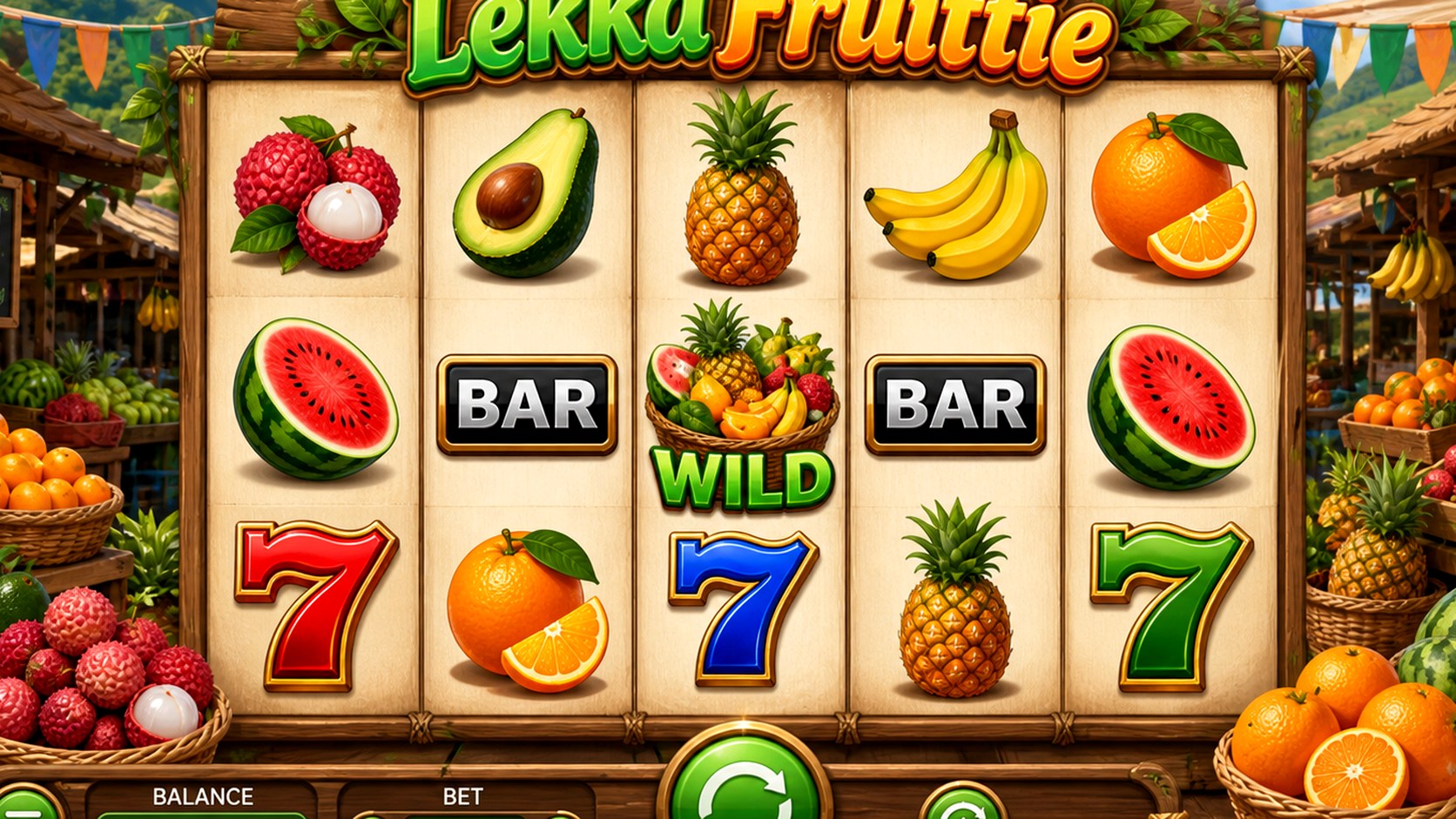
Por Fairy Editorial - 19 Aug 2026
Spirit of Adventure Review: The Relic Trail That Keeps Rewriting the Bonus
Espírito de Aventura
Spirit of Adventure Review: The Relic Trail That Keeps Rewriting the Bonus

Spirit of Adventure makes its central mechanism visible early: four relic trails and the remaining-spin counter. The accessible product material describes a 96.60 percent default return and high volatility, but the operator build may use another certified return setting. The useful question is not how loud the feature looks, but how each debit becomes a traceable credit. Reel Kingdom and operator rule summaries identify a five-reel, three-row game with ten fixed paylines, 8, 10 or 12 starting free spins from three, four or five Bonus symbols, an Island Bonus confined to reel three, a moving collector Wild, relic trails and a 5,100-times maximum award. Exact regional terms still belong to the running client. All three horizontal pictures are original editorial reconstructions based on published game rules. They are not Reel Kingdom screenshots, records of a wager or proof that the illustrated relics were collected. This review uses a strict evidence order. The deployed help screen ranks first, then a studio sheet, studio product page, regulated operator rules and finally independent catalogues. Artwork proves theme and identity; it does not prove reel strips, probability, feature frequency or an operator return setting. No paid wager was placed and no age gate was bypassed. The accessible pages did not expose a legally open client that could be tested without confirmation, so there is no claimed personal hit rate, balance result or bonus sample. Published mechanics are mapped to checks that can be repeated when the Philippine build is opened by an eligible user. The three wide pictures keep the discussion concrete on a phone-shaped canvas. Their values, counters and positions are explanatory props. They must not be presented as original studio screenshots or as evidence of a win.

A useful test session should therefore be recorded as a sequence rather than remembered as a mood. Note the selected stake, starting balance, round identifier, ordinary line or ways return, feature entry cost, each modifier, every counter movement and the final credited amount. That record cannot predict later rounds, but it can expose a misunderstood rule, a missed reset or a display total that needs support review. The same discipline applies to comparisons with related titles. Shared characters and familiar symbols do not guarantee shared mathematics. A sequel may change its reel strips, return setting, bonus price, maximum award or retrigger schedule while preserving almost the same artwork. This article treats the exact named version as its own product and avoids transferring assumptions from neighbouring games in the catalogue.

The Map Before Takeoff

Spirit of Adventure opens with methodical expedition accounting. The aviator archaeologist collector Wild and masks, chalices, shields, diamonds, relics, bonus emblems and a moving totem are not background ornaments; they form a visual hierarchy that tells the eye where to look before any rule has been read. The reel area sits inside that hierarchy, so symbols remain distinct from the scenery instead of dissolving into it.

That first reading matters on a phone. A slot may spend heavily on illustration and still fail if the stake, spin control or settled result is hard to locate. Here the strongest idea is not mere decoration. It is the way deep jungle green, weathered stone, turquoise and old gold separates the game board, framing art and controls into layers.

What the Public Rules Confirm

Reel Kingdom and operator rule summaries identify a five-reel, three-row game with ten fixed paylines, 8, 10 or 12 starting free spins from three, four or five Bonus symbols, an Island Bonus confined to reel three, a moving collector Wild, relic trails and a 5,100-times maximum award. The accessible product material describes a 96.60 percent default return and high volatility, but the operator build may use another certified return setting.

These published figures define the review frame. The active information panel still outranks catalogue copy for the return variant, stake range, cash limit and any disabled feature in the operator build.

Reading 96.60 Percent Without Forecasting

The commonly published default RTP is 96.60 percent, with lower certified variants reported in some catalogues. That number is a long-run model for one configuration, not a session score or a clue about the next relic.

High volatility describes an uneven distribution. It does not mean that raising stake improves access to the Island Bonus, trail completion or the totem phase.

Adventure Is a Sequence of States

The word Adventure is the headline hook. It raises an obvious question: does it describe a multiplier, a progression, a visual motif or simply the scale of the story? Only the help screen can answer that. A number or power word in a logo is not automatically the highest cash ratio for a paid round.

Before treating the title as a promise, locate the line that defines it. Check the triggering symbols, the stage at which the value applies, any stake multiplier, the cap on simultaneous wins and any separate cash ceiling. If those conditions are absent, the name should remain a marketing label rather than a calculation.

Five Reels, Three Rows and Ten Paths

The reconstruction follows the published five-by-three cabinet and ten-line structure. The operator paytable remains the authority for exact line paths, stake limits, return configuration and any jurisdictional cash ceiling.

The board shape is only the first part of settlement. A player must also verify direction, minimum match length, line or ways unit, Wild exclusions and how simultaneous components are added.

Masks, Chalices, Shields and Diamonds

The theme naturally divides the reel set into character or object symbols, special icons and carved masks, cups and shields. masks, chalices, shields, diamonds, relics, bonus emblems and a moving totem carry more visual weight than the letters and numbers. That weight usually signals premium status, but the paytable may rank two similar objects very differently. Size and shine are clues, never final values.

Read every payout in the unit used by the game. Some tables show bet-per-line units; others use total stake. A five-of-a-kind figure can appear ten or twenty times larger if the unit is misunderstood. The cash meter after a test spin is useful, but the written help panel should settle the conversion.

The Small Symbols Still Settle First

carved masks, cups and shields occupy a large share of ordinary reel time in the editorial layout. They create visual breathing room around the premium art and make small combinations quick to recognize. Their role in the mathematical model may be larger than their small paytable values suggest because frequency and value are separate parts of return.

A low-symbol hit can light the grid while returning less than the amount staked. That is a paid result, not necessarily a profitable round. The correct comparison is final credit divided by the full spin cost. Animation length, coin count and sound volume do not change that ratio.

Tracing a Line Through the Ruins

Large portraits and objects such as masks, chalices, shields, diamonds, relics, bonus emblems and a moving totem can dominate the frame. The practical test is to follow one settled combination from its first symbol to its last without relying on flashing borders. Clear spacing between reels, consistent icon silhouettes and a visible route make the result easier to audit.

If several awards arrive together, open the win breakdown or history panel. One total may contain multiple lines, an anywhere payment and a modifier. Treating the largest symbol on screen as the sole cause can produce a false reading of the rule, especially when a substitute or multiplier is also present.

The Collector Wild Moves Every Spin

The adventurer Wild appears in free spins, shifts to a random position on each action and substitutes for ordinary symbols. Its second job is more important: it collects values from relics in the eight surrounding positions.

Adjacency therefore means horizontal, vertical and diagonal contact around one cell. A valuable relic elsewhere on the board is decoration for that spin unless another rule moves or collects it.

Two Roads Into Free Spins

Three, four or five standard Bonus symbols award 8, 10 or 12 free spins. The Island Bonus appears only on reel three and starts the feature with 12 actions.

Inside the feature, an Island symbol adds random relics with random values. It changes the current board rather than merely adding another Scatter payment.

Four Relic Trails on One Screen

Collected relic types fill separate trails. Public rules describe thresholds of four blue for 2 times, four red for 3 times, three green for 5 times and three gold for 10 times.

A completed trail also replenishes free spins by three to five, but the remaining counter cannot rise above the amount initially awarded. That cap is easy to miss when the animation celebrates an extension.

Base Spins Before the Expedition Opens

Many reviews rush past the paid reels and treat the bonus as the only meaningful part. That misses the money path. Base spins create nearly all turnover, settle small and medium awards, and decide how long a balance remains available. A rare feature cannot repair a stake level that is too high for the intended session.

Spirit of Adventure needs ordinary results that are readable at a glance. A clean board lets the user distinguish a no-win, a partial return and a profit without waiting for a long count-up. That clarity is especially important when the surrounding overgrown jungle temple and island ruins is busy and the screen uses strong motion.

The Relic Hunt Step by Step

Each free spin relocates the Wild, evaluates ordinary lines and then resolves nearby relic collection under the published sequence. Trail progress changes the value of later relics of that type.

After the guaranteed counter ends, a totem appears and moves along with the Wild. Single extra actions persist until the two occupy the same position; this creates an open-ended tail without promising a long run.

How Trail Multipliers Attach to Values

Trail multipliers belong to their relic categories. A gold trail reaching 10 times does not automatically multiply ordinary line wins, other relic colors or the full feature total.

History should show the relic face value, category multiplier and credited component. Without that breakdown, manually reconstruct the feature from screenshots taken before each spin settles.

Why 5,100 Times Is a Ceiling

Clients often label results with tiers such as big, mega or super. Those labels are commonly based on the ratio between win and current stake. They do not prove that the result reached the mathematical ceiling. The count-up may also stop at a cash cap even when the theoretical symbol total is higher.

To calculate a genuine ratio, divide the credited result by the total stake removed for the paid round. Include free follow-up actions inside that same round unless the rules state otherwise. This method turns a loud presentation into a comparable number and avoids confusing coins on screen with peso value.

Picture One: The Jungle Reconstruction

The first picture places an original aviator beside a five-by-three jungle board, with an Island Bonus marker and trail panel visible at the edges. It is a wide explanatory composition rather than a captured client frame.

The illustration belongs to the editorial layer. It cannot certify probability, reel strips, a balance or a real feature trigger.

Picture Two: Collector and Adjacent Relics

The second picture tightens the view around the collector Wild and nearby relic positions. It shows why adjacency matters, but the numeric values and positions are illustrative only.

The close view helps separate symbol roles and screen zones. The client history remains the correct evidence for a settled round.

Picture Three: Island, Trails and Totem

The third picture centres the Island Bonus, trail counters and totem vocabulary. It maps the sequence described by the rules without claiming that a live bonus reached that state.

The image turns a complicated rule tree into visible parts, but only the live rules establish which parts can coexist.

Expedition log 19: Sound Design and Perceived Pace

methodical expedition accounting can be strengthened through layered music, reel-stop cues and short feature stingers. Sound is useful when it marks a trigger or completed calculation. It becomes less useful when every partial return receives the same fanfare as a clear profit.

Try several rounds with audio lowered. If the board still communicates outcome, the interface is doing its job. If the result becomes ambiguous without a voice line or long count-up, the visual feedback needs more attention. Audio should confirm settlement, not replace the numbers.

Expedition log 20: Landscape Play and Thumb Reach

A horizontal phone gives the overgrown jungle temple and island ruins room on both sides of the reels. The central board remains large while settings, stake controls and spin can occupy the lower band. This arrangement works best when the largest button sits away from the minus and plus controls.

Before rapid play, rotate the device, enter full screen and check the total-stake field after one adjustment. Browser bars and system gestures can cover edge controls. A test spin at the minimum setting confirms that the hit boxes match the visible buttons and that no accidental Max Bet control sits beneath the thumb.

Expedition log 21: Portrait Mode Is a Compromise

Portrait layout may scale the entire game down or reorganize controls beneath the grid. Tiny payline markers and condensed help text are the first casualties. The screen can remain playable, yet accurate rule reading becomes harder when the table requires repeated zooming or horizontal swipes.

Use portrait mode for quick navigation, not for the first rules check. Landscape is the better place to compare total stake, balance and win because all three can remain visible together. The relationship between those numbers matters more than keeping the device in one hand.

Expedition log 22: Performance on Mid-Range Phones

The artwork uses multiple layers, large character cutouts and particle effects. On a mid-range handset, watch for delayed button response after a count-up, audio falling out of step with the reels or a stake change taking effect one round late. Those are interface problems, not signs of altered probability.

Close other heavy apps and use a stable connection during the first session. If the client reconnects, verify balance and the last completed round in history before spinning again. A frozen animation can recover after the server has already settled the result, so the account record takes priority over the last visible frame.

Expedition log 23: Stake Controls Deserve More Attention Than the Mascot

The moving Wild and four progress trails create several simultaneous narratives, which can make a long bonus feel productive even when the final amount remains small beside its trigger cost. The most useful habit is to read total stake after every change and before the first rapid sequence. Bet per line, coin value and total bet may occupy separate fields, and altering one can multiply the final debit.

A planned session should be written in money, spins and time. Divide the session amount by the intended number of paid rounds to find a workable average stake. Free actions do not add a new debit unless the client states a purchase. This arithmetic is dull, but it controls exposure more reliably than any theme-based hunch.

Expedition log 24: RTP Belongs to Turnover, Not a Short Run

Once the deployed RTP is known, interpret it as a long-run model ratio. If the help page lists 96 percent, theoretical cost is four units per hundred units of turnover. That sentence is an example of the calculation, not a claim that this version uses 96 percent.

Turnover equals total paid stake across accepted rounds. A hundred spins at one unit create one hundred units of turnover even if several free actions appear between them. A short session may finish far above or below the model ratio because random outcomes do not settle into a neat percentage on demand.

Expedition log 25: Volatility Is About Distribution

Volatility describes how payout value is spread across outcomes. A higher band usually places more weight in less common large results; a lower band usually returns more of its value through smaller payments. The label does not state when a feature will arrive or how long a losing sequence can last.

Without an official band, infer nothing from methodical expedition accounting. A calm fruit village can use severe math, and a battlefield can use a mild distribution. After the label is found, use it to size stake and session length, not to forecast the next reel stop.

Expedition log 26: Maximum Win Needs a Denominator

The published ceiling is 5,100 times total stake. Reaching it ends the round under the usual cap logic, but the figure does not reveal the probability of doing so.

The maximum is not a target created by trail progress. It is a hard boundary across line wins, relic collections and any final mystery choice, subject to a possible jurisdictional cash limit.

Expedition log 27: A Clean Demo Test in Thirty Paid Rounds

Use the minimum fixed stake and create one row for each paid round. Record starting balance, debit, base credit, feature credit, ending balance and any meter change. Keep free actions inside the row of the spin that triggered them. This format exposes the money flow without treating a tiny sample as statistical proof.

Thirty rounds are enough to learn button behavior, symbol settlement and feature messages. They are not enough to estimate RTP or trigger frequency. The purpose is mechanical literacy. Stop the test once each major control has been checked; more spins do not turn an informal sample into certification.

Expedition log 28: How to Audit a Bonus From Start to Finish

Capture the trigger screen, starting counter, carried stake and opening multiplier. Then note each retrigger, held symbol, expanding reel or meter reset. At the end, compare the feature total with the history record and final balance. Every free action should trace back to one paid round.

If a purchase button exists, treat it as a separate bet mode. Record its price as the full stake for that round and read its RTP entry independently if the client lists one. A purchased feature may use the same animation while carrying a different cost structure.

Expedition log 29: Common Misreads Around Spirit of Adventure

The first misread is assuming that Adventure states the unconditional top award. The second is assigning premium status solely from symbol size. The third is treating a filling four relic trails and the remaining-spin counter as proof that a feature is due. The fourth is calling every substitute a multiplier Wild without checking the rules.

The fifth is copying an RTP from an unrelated review. The sixth is counting free actions as fresh paid spins. The seventh is judging profit from the win banner instead of balance movement. Each mistake disappears when the player keeps the stake field, history panel and help page in the same audit.

Expedition log 30: What Philippine Players Should Verify

A Philippine listing may use peso values, wallet credits or a converted coin display. Confirm the minimum and maximum total stake, not merely coin size. Check that the operator names Reel Kingdom Games as the studio, and compare the logo with the official key art before assuming that a similarly named title is the same product.

Also read local rules for feature purchases, autoplay, session reminders and cash limits. These controls belong to the operator build and jurisdiction. A screenshot from another market can explain layout, but it cannot establish the available stake range or certified return in a Philippine account.

Expedition log 31: Who Gets the Most From This Theme

Readers who like high-volatility collector bonuses in which position, trail progress and extra actions matter more than the ordinary jungle symbols will find the presentation immediately legible. The theme also suits short review sessions because the visual hierarchy can be judged quickly. That does not make the mathematical profile suitable for every budget; the actual volatility and minimum total stake still control that decision.

Anyone who dislikes dense side art or loud event effects should test the sound and fast-play controls first. A strong theme can be a reason to open a demo, but it is not a reason to ignore the paytable. Interest in the artwork and comfort with the stake are separate choices.

Expedition log 32: A Practical Decision Checklist

Before real play, confirm the exact title, studio, RTP, volatility, win method, Wild exceptions, Scatter route, feature trigger, multiplier scope, maximum-win denominator and cash cap. Then set a total session amount and a stopping time. If any critical rule remains hidden, keep the title in demo mode.

During play, watch balance rather than animation. After play, compare opening balance, deposits, withdrawals and ending balance with the history log. This checklist does not change random results. It changes how clearly the cost and settlement can be seen.

Expedition log 33: Final Reading: Theme First, Math Before Money

Spirit of Adventure has a genuinely layered feature model. Its strength lies in the interaction among adjacent relic collection, trail upgrades, capped replenishment and the uncertain totem phase; its weakness is the amount of bookkeeping required to understand the settlement

Spirit of Adventure earns attention through methodical expedition accounting and a tightly coordinated deep jungle green, weathered stone, turquoise and old gold palette. The next step is not a larger stake; it is the local information screen. Confirm the deployed math, test the controls at minimum value and treat every visual promise as a question that the rules must answer.

Expedition log 34: Separating Hit Rate From Profit Rate

A hit is any result the rules count as a payment. Profit requires the credited amount to exceed the full stake for that paid round. A title can register frequent small hits while the balance declines. Without an official hit-frequency figure, the only safe statement is that the two rates are not interchangeable.

For a demo log, mark return ratios below 1x, exactly 1x and above 1x in separate columns. This reveals how many recorded wins were partial returns. It still does not predict future play, but it gives a much clearer account of the sample than a simple count of flashing win messages.

Expedition log 35: Near Misses Are Animation, Not Progress

A bonus icon stopping just outside a payline or a premium symbol passing during reel motion can feel meaningful. Unless the written rule stores that event, it has no carry-over value. The next accepted round is not improved because the previous animation looked close.

The same caution applies to two trigger symbols when three are required. They may create suspense, yet their payment and stored effect depend entirely on the table. Record what was credited, then clear the image from the decision about the next stake.

Expedition log 36: Fast Play Changes Exposure Speed

Fast play shortens animation; it does not normally change the random model. Its financial effect comes from time. More paid rounds can fit into the same minute, so the balance may move faster even though the stake per round stays fixed.

Measure pace before enabling it. Ten ordinary rounds on standard speed and ten on fast speed reveal the difference in turnover per minute. If the faster rate breaks the planned session limit, lower the stake or return to standard timing rather than relying on attention alone.

Expedition log 37: Autoplay Needs Stop Conditions

Where autoplay is available, set a round count and use any loss, win or single-award limits shown by the client. Read those fields carefully because some are cash values while others are stake multipliers. An empty field may mean no automatic stop for that condition.

Remain present during automated rounds. Network reconnection, a feature choice or a changed balance can pause the sequence. Autoplay is a convenience control, not a budget system, and it does not make a long sample more likely to follow the theoretical return.

Expedition log 38: Responsible Play in Plain Numbers

Set a sum that can be lost without affecting bills, savings or debt payments. Do not borrow to play, do not chase a prior loss and do not treat a rare large result as income. Time reminders and deposit limits are useful because strong game art can blur the length of a session.

If play stops feeling optional, close the client and use the operator exclusion or limit tools. The clearest review of any slot ends with the same fact: outcomes are random, the house keeps a mathematical margin over long turnover and no visual pattern creates a reliable edge.
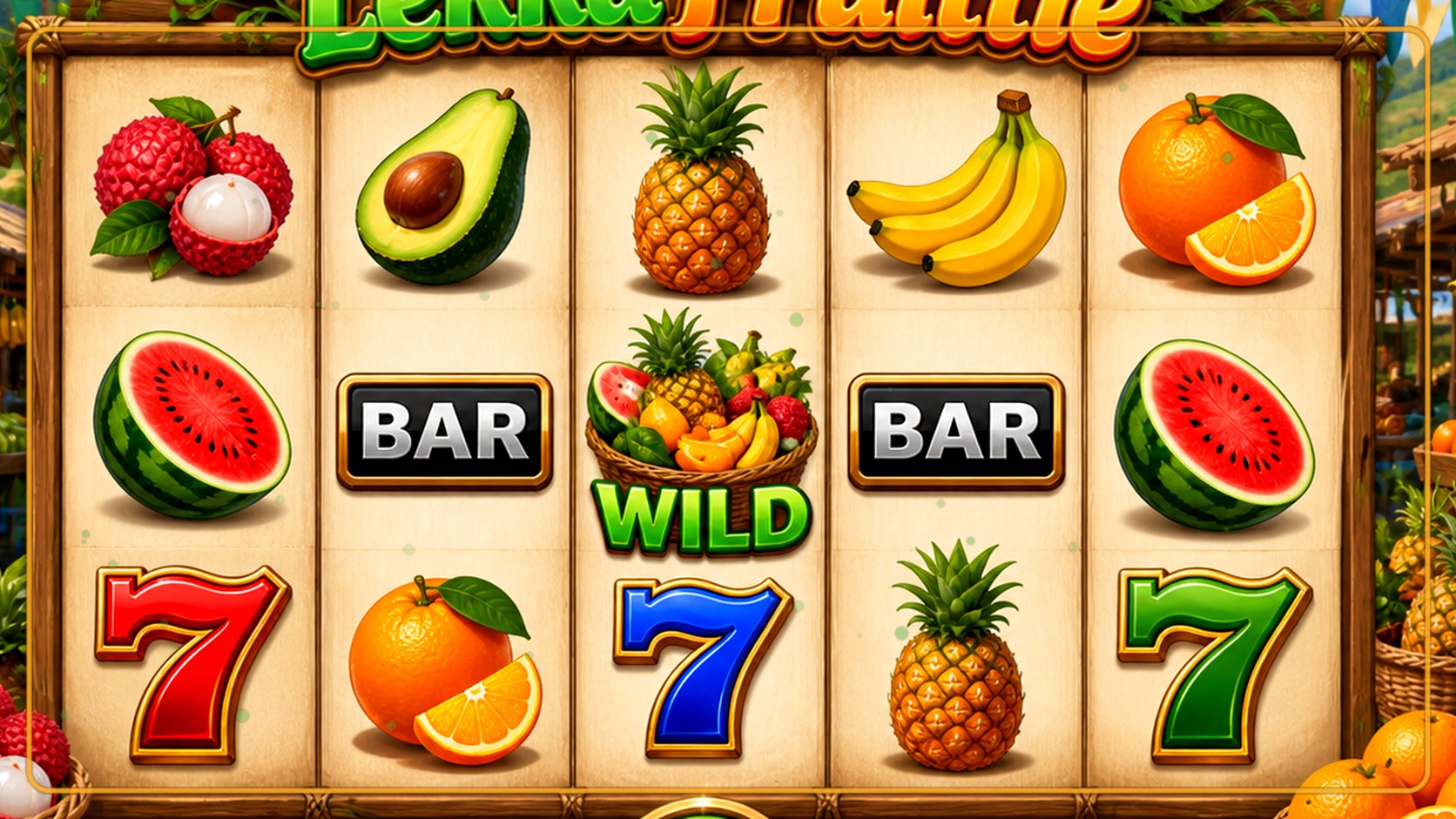
Por Fairy Editorial - 18 Aug 2026
Toilet Rolls Review: Paper Towers, Clean Reels and Messy Data
Rolos de Papel Higiênico
Toilet Rolls Review: Paper Towers, Clean Reels and Messy Data

Toilet Rolls starts with a title that makes the theme clear before a reel turns. The two public listings support the title and provider, but the playable client did not load for a direct rules check. That gives the article a visual direction, but not permission to fill missing rules with assumptions. Stake publicly identifies Toilet Rolls as a Daffy Studios title and shows a 2.50 percent edge; a secondary catalogue separately lists 97.5 percent return, high volatility, 15 ways and a 10000x maximum. Exact RTP, volatility, feature frequency and maximum-award conditions therefore remain version checks wherever the public record is incomplete or contradictory. All three pictures are editorial reconstructions built for this review. They do not claim to reproduce Daffy Studios artwork, a certified reel layout or a live winning result.

Entering the Paper Warehouse

Toilet Rolls opens with clean supply-room absurdity. The cheerful maintenance mascot and paper rolls, holders, rubber ducks, soap, plungers, water drops and crowns are not background ornaments; they form a visual hierarchy that tells the eye where to look before any rule has been read. The reel area sits inside that hierarchy, so symbols remain distinct from the scenery instead of dissolving into it.

That first reading matters on a phone. A slot may spend heavily on illustration and still fail if the stake, spin control or settled result is hard to locate. Here the strongest idea is not mere decoration. It is the way porcelain white, aqua blue, coral and polished gold separates the game board, framing art and controls into layers.

What Stake and the Directory Confirm

Stake publicly identifies Toilet Rolls as a Daffy Studios title and shows a 2.50 percent edge; a secondary catalogue separately lists 97.5 percent return, high volatility, 15 ways and a 10000x maximum. The two public listings support the title and provider, but the playable client did not load for a direct rules check. This is the firm boundary of the evidence used here.

A catalogue image can establish identity and art direction. It cannot establish the exact RTP setting, volatility band, reel mathematics, bet limits or highest award in every operator build. Those facts belong to the information panel of the version actually loaded.

Edge, Return and Version Control

No exact RTP is printed here because a first-party mathematical sheet for the deployed Philippine build was not available for direct inspection. Repeating a familiar percentage from another site would turn an information gap into false precision.

The same restraint applies to volatility, hit frequency, bonus frequency and maximum win. A secondary directory may list figures, but the running help page and operator rules take priority because certified configurations and regional limits can differ.

What Rolls Means Beyond the Joke

The word Rolls is the headline hook. It raises an obvious question: does it describe a multiplier, a progression, a visual motif or simply the scale of the story? Only the help screen can answer that. A number or power word in a logo is not automatically the highest cash ratio for a paid round.

Before treating the title as a promise, locate the line that defines it. Check the triggering symbols, the stage at which the value applies, any stake multiplier, the cap on simultaneous wins and any separate cash ceiling. If those conditions are absent, the name should remain a marketing label rather than a calculation.

Inspecting the Reel Fixtures

Start with the shape of the board and the rule used to recognize a result. A wide image can represent fixed paylines, adjacent ways, clusters, symbol counts or another method. The visible columns alone do not answer the question.

The reconstruction uses five reels, while a secondary source labels the game as 15 ways. That wording must be checked in the client because 15 could refer to fixed paths, selectable lines or another counting method.

Paper, Soap and Hardware Symbols

The theme naturally divides the reel set into character or object symbols, special icons and small hygiene and water icons. paper rolls, holders, rubber ducks, soap, plungers, water drops and crowns carry more visual weight than the letters and numbers. That weight usually signals premium status, but the paytable may rank two similar objects very differently. Size and shine are clues, never final values.

Read every payout in the unit used by the game. Some tables show bet-per-line units; others use total stake. A five-of-a-kind figure can appear ten or twenty times larger if the unit is misunderstood. The cash meter after a test spin is useful, but the written help panel should settle the conversion.

Small Icons on a White Background

small hygiene and water icons occupy a large share of ordinary reel time in the editorial layout. They create visual breathing room around the premium art and make small combinations quick to recognize. Their role in the mathematical model may be larger than their small paytable values suggest because frequency and value are separate parts of return.

A low-symbol hit can light the grid while returning less than the amount staked. That is a paid result, not necessarily a profitable round. The correct comparison is final credit divided by the full spin cost. Animation length, coin count and sound volume do not change that ratio.

Can the Win Route Pass Inspection

Large portraits and objects such as paper rolls, holders, rubber ducks, soap, plungers, water drops and crowns can dominate the frame. The practical test is to follow one settled combination from its first symbol to its last without relying on flashing borders. Clear spacing between reels, consistent icon silhouettes and a visible route make the result easier to audit.

If several awards arrive together, open the win breakdown or history panel. One total may contain multiple lines, an anywhere payment and a modifier. Treating the largest symbol on screen as the sole cause can produce a false reading of the rule, especially when a substitute or multiplier is also present.

A Roll Wild Needs Specifications

A Wild description is incomplete until three points are known: which symbols it copies, where it can land and if it carries its own value or multiplier. It may exclude Scatters, bonus icons or jackpots. Some Wilds expand or stay in place; others do nothing beyond substitution. The artwork cannot settle those exceptions.

When a Wild appears, compare the marked winning path with the natural symbols around it. Then check if the game pays the best valid combination or adds a separate Wild award. This small audit prevents a common error in which every decorated emblem is assumed to copy everything on the board.

Scatter Placement on the Supply Plan

A Scatter generally counts across specified reels or anywhere on the grid, but the required count and eligible positions vary. Three matching icons might start a feature in one version and merely pay in another. Some titles require the first, third and fifth reels; others accept any three positions.

Record the full trigger screen before naming the rule. Count the symbols, note their reels and wait for the award message. If the next screen changes mode, check the starting counter and carried stake. One observed trigger explains a route; it does not estimate how often that route will happen.

A Stack Counter Is Not Stored Value

any roll stack or supply counter in the client should be treated as an interface question, not a prediction. If the deployed client displays it, the help page must say what moves it, when it resets and if any progress survives the next paid round.

Watch one complete cycle before assigning meaning. A circle, gauge or counter may show collected symbols, a one-round modifier, a bonus threshold or only decorative state. A nearly full graphic does not prove that a feature is due.

Ordinary Spins Move the Inventory

Many reviews rush past the paid reels and treat the bonus as the only meaningful part. That misses the money path. Base spins create nearly all turnover, settle small and medium awards, and decide how long a balance remains available. A rare feature cannot repair a stake level that is too high for the intended session.

Toilet Rolls needs ordinary results that are readable at a glance. A clean board lets the user distinguish a no-win, a partial return and a profit without waiting for a long count-up. That clarity is especially important when the surrounding spotless bathroom-supply warehouse is busy and the screen uses strong motion.

What a Collection Mode Must Change

any paper-roll collection mode named by the help page earns a separate name only if it changes a rule. It might alter the grid, symbol set, multiplier scope, number of actions or settlement method. A new background and louder sound are presentation changes, not new math.

Compare the help text before and after the mode begins. Record any carried stake, starting counter, retrigger condition and cap. If none of these elements changes, describe the event as an animation state rather than a distinct bonus mechanism.

Connecting the Multiplier

A multiplier can act on one symbol, one line, the current cascade, all wins in a free-spin round or the final feature total. Saying that a game has multipliers leaves the crucial calculation unanswered. The placement of the number and the wording of the win message usually reveal the scope.

Also check if several multipliers add or multiply together. Two visible 2x values could mean 4x, a combined 4x through addition, or separate modifiers on different awards. The history entry after settlement is the safest way to test. Never extrapolate the top result from a promotional badge alone.

A Loud Flush Is Not the Maximum

Clients often label results with tiers such as big, mega or super. Those labels are commonly based on the ratio between win and current stake. They do not prove that the result reached the mathematical ceiling. The count-up may also stop at a cash cap even when the theoretical symbol total is higher.

To calculate a genuine ratio, divide the credited result by the total stake removed for the paid round. Include free follow-up actions inside that same round unless the rules state otherwise. This method turns a loud presentation into a comparable number and avoids confusing coins on screen with peso value.

Picture One: The Editorial Warehouse

The first picture turns rolls, tiled walls and a warehouse conveyor into a wide review visual. Its clean humor is tied to the title, not presented as sourced Daffy Studios art.

The picture belongs to the visual review only. It must never be used as a substitute for a paytable, probability statement or operator-specific stake range.

Picture Two: A Closer Control Panel

The second picture tightens the view around the imagined reels and lower controls. Empty balance fields and symbol positions remain illustrative and have no relation to an actual account.

Its job is to make phone layout, symbol hierarchy and control placement easier to discuss. The written rules remain the authority for every cash calculation.

Picture Three: Product Symbol Check

The third picture enlarges paper rolls, holders, soap, ducks, water drops, crowns and plungers. It helps assess contrast on mobile but proves nothing about symbol values or feature behavior.

A live history panel should show more than any promotional still: original stake, component awards, modifiers and final credit. That record is the correct place to audit settlement.

Supply audit 19: Sound Design and Perceived Pace

clean supply-room absurdity can be strengthened through layered music, reel-stop cues and short feature stingers. Sound is useful when it marks a trigger or completed calculation. It becomes less useful when every partial return receives the same fanfare as a clear profit.

Try several rounds with audio lowered. If the board still communicates outcome, the interface is doing its job. If the result becomes ambiguous without a voice line or long count-up, the visual feedback needs more attention. Audio should confirm settlement, not replace the numbers.

Supply audit 20: Landscape Play and Thumb Reach

A horizontal phone gives the spotless bathroom-supply warehouse room on both sides of the reels. The central board remains large while settings, stake controls and spin can occupy the lower band. This arrangement works best when the largest button sits away from the minus and plus controls.

Before rapid play, rotate the device, enter full screen and check the total-stake field after one adjustment. Browser bars and system gestures can cover edge controls. A test spin at the minimum setting confirms that the hit boxes match the visible buttons and that no accidental Max Bet control sits beneath the thumb.

Supply audit 21: Portrait Mode Is a Compromise

Portrait layout may scale the entire game down or reorganize controls beneath the grid. Tiny payline markers and condensed help text are the first casualties. The screen can remain playable, yet accurate rule reading becomes harder when the table requires repeated zooming or horizontal swipes.

Use portrait mode for quick navigation, not for the first rules check. Landscape is the better place to compare total stake, balance and win because all three can remain visible together. The relationship between those numbers matters more than keeping the device in one hand.

Supply audit 22: Performance on Mid-Range Phones

The artwork uses multiple layers, large character cutouts and particle effects. On a mid-range handset, watch for delayed button response after a count-up, audio falling out of step with the reels or a stake change taking effect one round late. Those are interface problems, not signs of altered probability.

Close other heavy apps and use a stable connection during the first session. If the client reconnects, verify balance and the last completed round in history before spinning again. A frozen animation can recover after the server has already settled the result, so the account record takes priority over the last visible frame.

Supply audit 23: Stake Controls Deserve More Attention Than the Mascot

The visual joke is immediate and can keep attention on growing paper towers instead of the total stake removed over time. The most useful habit is to read total stake after every change and before the first rapid sequence. Bet per line, coin value and total bet may occupy separate fields, and altering one can multiply the final debit.

A planned session should be written in money, spins and time. Divide the session amount by the intended number of paid rounds to find a workable average stake. Free actions do not add a new debit unless the client states a purchase. This arithmetic is dull, but it controls exposure more reliably than any theme-based hunch.

Supply audit 24: RTP Belongs to Turnover, Not a Short Run

Once the deployed RTP is known, interpret it as a long-run model ratio. If the help page lists 96 percent, theoretical cost is four units per hundred units of turnover. That sentence is an example of the calculation, not a claim that this version uses 96 percent.

Turnover equals total paid stake across accepted rounds. A hundred spins at one unit create one hundred units of turnover even if several free actions appear between them. A short session may finish far above or below the model ratio because random outcomes do not settle into a neat percentage on demand.

Supply audit 25: Volatility Is About Distribution

Volatility describes how payout value is spread across outcomes. A higher band usually places more weight in less common large results; a lower band usually returns more of its value through smaller payments. The label does not state when a feature will arrive or how long a losing sequence can last.

Without an official band, infer nothing from clean supply-room absurdity. A calm fruit village can use severe math, and a battlefield can use a mild distribution. After the label is found, use it to size stake and session length, not to forecast the next reel stop.

Supply audit 26: Maximum Win Needs a Denominator

A maximum written as 1000x or 5000x must say what x means. It may refer to total bet, coin value, feature stake or a base amount before an ante. Some clients also apply a fixed cash ceiling. The lower of the mathematical award and cash cap may be the amount actually credited.

Check if the cap ends the feature immediately or allows remaining actions to play without added credit. Also check if simultaneous line, Scatter and jackpot awards share one cap. A headline number without these conditions is incomplete and should never be used to set a spending target.

Supply audit 27: A Clean Demo Test in Thirty Paid Rounds

Use the minimum fixed stake and create one row for each paid round. Record starting balance, debit, base credit, feature credit, ending balance and any meter change. Keep free actions inside the row of the spin that triggered them. This format exposes the money flow without treating a tiny sample as statistical proof.

Thirty rounds are enough to learn button behavior, symbol settlement and feature messages. They are not enough to estimate RTP or trigger frequency. The purpose is mechanical literacy. Stop the test once each major control has been checked; more spins do not turn an informal sample into certification.

Supply audit 28: How to Audit a Bonus From Start to Finish

Capture the trigger screen, starting counter, carried stake and opening multiplier. Then note each retrigger, held symbol, expanding reel or meter reset. At the end, compare the feature total with the history record and final balance. Every free action should trace back to one paid round.

If a purchase button exists, treat it as a separate bet mode. Record its price as the full stake for that round and read its RTP entry independently if the client lists one. A purchased feature may use the same animation while carrying a different cost structure.

Supply audit 29: Common Misreads Around Toilet Rolls

The first misread is assuming that Rolls states the unconditional top award. The second is assigning premium status solely from symbol size. The third is treating a filling any roll stack or supply counter in the client as proof that a feature is due. The fourth is calling every substitute a multiplier Wild without checking the rules.

The fifth is copying an RTP from an unrelated review. The sixth is counting free actions as fresh paid spins. The seventh is judging profit from the win banner instead of balance movement. Each mistake disappears when the player keeps the stake field, history panel and help page in the same audit.

Supply audit 30: What Philippine Players Should Verify

A Philippine listing may use peso values, wallet credits or a converted coin display. Confirm the minimum and maximum total stake, not merely coin size. Check that the operator names Daffy Studios as the studio, and compare the logo with the official key art before assuming that a similarly named title is the same product.

Also read local rules for feature purchases, autoplay, session reminders and cash limits. These controls belong to the operator build and jurisdiction. A screenshot from another market can explain layout, but it cannot establish the available stake range or certified return in a Philippine account.

Supply audit 31: Who Gets the Most From This Theme

Readers who like novelty slots, spotless comic art and everyday objects turned into exaggerated reel symbols will find the presentation immediately legible. The theme also suits short review sessions because the visual hierarchy can be judged quickly. That does not make the mathematical profile suitable for every budget; the actual volatility and minimum total stake still control that decision.

Anyone who dislikes dense side art or loud event effects should test the sound and fast-play controls first. A strong theme can be a reason to open a demo, but it is not a reason to ignore the paytable. Interest in the artwork and comfort with the stake are separate choices.

Supply audit 32: A Practical Decision Checklist

Before real play, confirm the exact title, studio, RTP, volatility, win method, Wild exceptions, Scatter route, feature trigger, multiplier scope, maximum-win denominator and cash cap. Then set a total session amount and a stopping time. If any critical rule remains hidden, keep the title in demo mode.

During play, watch balance rather than animation. After play, compare opening balance, deposits, withdrawals and ending balance with the history log. This checklist does not change random results. It changes how clearly the cost and settlement can be seen.

Supply audit 33: Final Reading: Theme First, Math Before Money

Toilet Rolls is silly on purpose and the theme is easy to recognize. Public numbers are unusually specific, but they still need confirmation in the deployed rules because edge, return and maximum claims can vary by configuration

Toilet Rolls earns attention through clean supply-room absurdity and a tightly coordinated porcelain white, aqua blue, coral and polished gold palette. The next step is not a larger stake; it is the local information screen. Confirm the deployed math, test the controls at minimum value and treat every visual promise as a question that the rules must answer.

Supply audit 34: Separating Hit Rate From Profit Rate

A hit is any result the rules count as a payment. Profit requires the credited amount to exceed the full stake for that paid round. A title can register frequent small hits while the balance declines. Without an official hit-frequency figure, the only safe statement is that the two rates are not interchangeable.

For a demo log, mark return ratios below 1x, exactly 1x and above 1x in separate columns. This reveals how many recorded wins were partial returns. It still does not predict future play, but it gives a much clearer account of the sample than a simple count of flashing win messages.

Supply audit 35: Near Misses Are Animation, Not Progress

A bonus icon stopping just outside a payline or a premium symbol passing during reel motion can feel meaningful. Unless the written rule stores that event, it has no carry-over value. The next accepted round is not improved because the previous animation looked close.

The same caution applies to two trigger symbols when three are required. They may create suspense, yet their payment and stored effect depend entirely on the table. Record what was credited, then clear the image from the decision about the next stake.

Supply audit 36: Fast Play Changes Exposure Speed

Fast play shortens animation; it does not normally change the random model. Its financial effect comes from time. More paid rounds can fit into the same minute, so the balance may move faster even though the stake per round stays fixed.

Measure pace before enabling it. Ten ordinary rounds on standard speed and ten on fast speed reveal the difference in turnover per minute. If the faster rate breaks the planned session limit, lower the stake or return to standard timing rather than relying on attention alone.

Supply audit 37: Autoplay Needs Stop Conditions

Where autoplay is available, set a round count and use any loss, win or single-award limits shown by the client. Read those fields carefully because some are cash values while others are stake multipliers. An empty field may mean no automatic stop for that condition.

Remain present during automated rounds. Network reconnection, a feature choice or a changed balance can pause the sequence. Autoplay is a convenience control, not a budget system, and it does not make a long sample more likely to follow the theoretical return.

Supply audit 38: Responsible Play in Plain Numbers

Set a sum that can be lost without affecting bills, savings or debt payments. Do not borrow to play, do not chase a prior loss and do not treat a rare large result as income. Time reminders and deposit limits are useful because strong game art can blur the length of a session.

If play stops feeling optional, close the client and use the operator exclusion or limit tools. The clearest review of any slot ends with the same fact: outcomes are random, the house keeps a mathematical margin over long turnover and no visual pattern creates a reliable edge.

Por Fairy Editorial - 18 Aug 2026
Heist Classic Review: The Vault Looks Rich, but the Rules Hold the Real Keys
Heist Classic
Heist Classic Review: The Vault Looks Rich, but the Rules Hold the Real Keys

Heist Classic puts its premise on screen before the first paid action: The available catalogue card confirms a green title treatment and provider identity, yet it contains a third-party directory watermark and was used only as a reference. The visible theme gives the review a place to start, but it cannot fill gaps in the rule sheet. A public game directory identifies Heist Classic as a GG Soft release dated 14 July 2025, but its fields for return, volatility, betways and maximum win remain blank and its demo is unavailable. Exact values from the active operator build take priority wherever public records are absent, contradictory or inaccessible. All three horizontal pictures are editorial reconstructions guided by the exact title, named studio and catalogue theme. They are not GG Soft screenshots, certified mechanics or records of real-money results.

This review uses a narrow evidence hierarchy. A first-party help panel in the deployed game would rank first, followed by a studio product page, then a public lobby record and finally a secondary catalogue. A picture may confirm visual identity, while a text listing may identify a grid or published return. Neither should be stretched into a claim about feature frequency, reel strips, random-number generation or the exact configuration used by a different operator. No paid wager was made for this article. The attempted public clients did not reach a usable game session, so there is no spin diary, hit-rate sample or personal balance result to report. The screen analysis instead asks what a Philippine player should verify once the local build opens: accepted stake, settlement unit, history entry, rule version, return setting, volatility label, maximum-award denominator and any separate cash limit. That is a more dependable review method than inventing a lucky session. The reconstructed pictures are designed to keep the discussion concrete on a phone-sized landscape canvas. Their controls, symbol positions, counters and values are props. They do not certify a pay route and must not be presented later as proof that a feature triggered. Where public material gives a specific layout, the artwork follows that broad structure; where the record is silent, the composition remains openly hypothetical. Every cash statement should still be checked against the accepted-round record after the screen has finished counting and before another action clears the display.

The Lock Before the First Spin

Heist Classic opens with quiet vault tension. The masked treasure thief and crowns, cut gems, keys, shields, treasure chests and armored guards are not background ornaments; they form a visual hierarchy that tells the eye where to look before any rule has been read. The reel area sits inside that hierarchy, so symbols remain distinct from the scenery instead of dissolving into it.

That first reading matters on a phone. A slot may spend heavily on illustration and still fail if the stake, spin control or settled result is hard to locate. Here the strongest idea is not mere decoration. It is the way deep teal, emerald green, torch amber and old gold separates the game board, framing art and controls into layers.

What the Catalogue Actually Proves

A public game directory identifies Heist Classic as a GG Soft release dated 14 July 2025, but its fields for return, volatility, betways and maximum win remain blank and its demo is unavailable. The available catalogue card confirms a green title treatment and provider identity, yet it contains a third-party directory watermark and was used only as a reference. This is the firm boundary of the evidence used here.

A catalogue image can establish identity and art direction. It cannot establish the exact RTP setting, volatility band, reel mathematics, bet limits or highest award in every operator build. Those facts belong to the information panel of the version actually loaded.

The Missing Math Is Part of the Review

No exact RTP is printed here because a first-party mathematical sheet for the deployed Philippine build was not available for direct inspection. Repeating a familiar percentage from another site would turn an information gap into false precision.

The same restraint applies to volatility, hit frequency, bonus frequency and maximum win. A secondary directory may list figures, but the running help page and operator rules take priority because certified configurations and regional limits can differ.

When Heist Is More Than a Theme

The word Heist is the headline hook. It raises an obvious question: does it describe a multiplier, a progression, a visual motif or simply the scale of the story? Only the help screen can answer that. A number or power word in a logo is not automatically the highest cash ratio for a paid round.

Before treating the title as a promise, locate the line that defines it. Check the triggering symbols, the stage at which the value applies, any stake multiplier, the cap on simultaneous wins and any separate cash ceiling. If those conditions are absent, the name should remain a marketing label rather than a calculation.

Mapping a Cabinet We Could Not Open

Start with the shape of the board and the rule used to recognize a result. A wide image can represent fixed paylines, adjacent ways, clusters, symbol counts or another method. The visible columns alone do not answer the question.

The artwork uses five vertical panels as an analytical layout. The public directory does not establish the real column count, row count or win method, so lines, ways and symbol adjacency must be read inside the operator client.

Crowns, Gems and Tools of the Job

The theme naturally divides the reel set into character or object symbols, special icons and small gem and shield icons. crowns, cut gems, keys, shields, treasure chests and armored guards carry more visual weight than the letters and numbers. That weight usually signals premium status, but the paytable may rank two similar objects very differently. Size and shine are clues, never final values.

Read every payout in the unit used by the game. Some tables show bet-per-line units; others use total stake. A five-of-a-kind figure can appear ten or twenty times larger if the unit is misunderstood. The cash meter after a test spin is useful, but the written help panel should settle the conversion.

Small Symbols in a Dark Vault

small gem and shield icons occupy a large share of ordinary reel time in the editorial layout. They create visual breathing room around the premium art and make small combinations quick to recognize. Their role in the mathematical model may be larger than their small paytable values suggest because frequency and value are separate parts of return.

A low-symbol hit can light the grid while returning less than the amount staked. That is a paid result, not necessarily a profitable round. The correct comparison is final credit divided by the full spin cost. Animation length, coin count and sound volume do not change that ratio.

Following a Result Past the Guards

Large portraits and objects such as crowns, cut gems, keys, shields, treasure chests and armored guards can dominate the frame. The practical test is to follow one settled combination from its first symbol to its last without relying on flashing borders. Clear spacing between reels, consistent icon silhouettes and a visible route make the result easier to audit.

If several awards arrive together, open the win breakdown or history panel. One total may contain multiple lines, an anywhere payment and a modifier. Treating the largest symbol on screen as the sole cause can produce a false reading of the rule, especially when a substitute or multiplier is also present.

The Wild Key Needs Three Teeth

A Wild description is incomplete until three points are known: which symbols it copies, where it can land and if it carries its own value or multiplier. It may exclude Scatters, bonus icons or jackpots. Some Wilds expand or stay in place; others do nothing beyond substitution. The artwork cannot settle those exceptions.

When a Wild appears, compare the marked winning path with the natural symbols around it. Then check if the game pays the best valid combination or adds a separate Wild award. This small audit prevents a common error in which every decorated emblem is assumed to copy everything on the board.

Where a Scatter May Enter the Vault

A Scatter generally counts across specified reels or anywhere on the grid, but the required count and eligible positions vary. Three matching icons might start a feature in one version and merely pay in another. Some titles require the first, third and fifth reels; others accept any three positions.

Record the full trigger screen before naming the rule. Count the symbols, note their reels and wait for the award message. If the next screen changes mode, check the starting counter and carried stake. One observed trigger explains a route; it does not estimate how often that route will happen.

A Loot Meter Cannot Predict the Next Round

any vault or loot counter in the deployed client should be treated as an interface question, not a prediction. If the deployed client displays it, the help page must say what moves it, when it resets and if any progress survives the next paid round.

Watch one complete cycle before assigning meaning. A circle, gauge or counter may show collected symbols, a one-round modifier, a bonus threshold or only decorative state. A nearly full graphic does not prove that a feature is due.

Ordinary Spins Pay for the Attempt

Many reviews rush past the paid reels and treat the bonus as the only meaningful part. That misses the money path. Base spins create nearly all turnover, settle small and medium awards, and decide how long a balance remains available. A rare feature cannot repair a stake level that is too high for the intended session.

Heist Classic needs ordinary results that are readable at a glance. A clean board lets the user distinguish a no-win, a partial return and a profit without waiting for a long count-up. That clarity is especially important when the surrounding moonlit castle vault is busy and the screen uses strong motion.

What a Vault Sequence Must Change

any heist or vault sequence named by the rules earns a separate name only if it changes a rule. It might alter the grid, symbol set, multiplier scope, number of actions or settlement method. A new background and louder sound are presentation changes, not new math.

Compare the help text before and after the mode begins. Record any carried stake, starting counter, retrigger condition and cap. If none of these elements changes, describe the event as an animation state rather than a distinct bonus mechanism.

Where Any Multiplier Is Applied

A multiplier can act on one symbol, one line, the current cascade, all wins in a free-spin round or the final feature total. Saying that a game has multipliers leaves the crucial calculation unanswered. The placement of the number and the wording of the win message usually reveal the scope.

Also check if several multipliers add or multiply together. Two visible 2x values could mean 4x, a combined 4x through addition, or separate modifiers on different awards. The history entry after settlement is the safest way to test. Never extrapolate the top result from a promotional badge alone.

Jumbo Fanfare Versus the Real Cap

Clients often label results with tiers such as big, mega or super. Those labels are commonly based on the ratio between win and current stake. They do not prove that the result reached the mathematical ceiling. The count-up may also stop at a cash cap even when the theoretical symbol total is higher.

To calculate a genuine ratio, divide the credited result by the total stake removed for the paid round. Include free follow-up actions inside that same round unless the rules state otherwise. This method turns a loud presentation into a comparable number and avoids confusing coins on screen with peso value.

Picture One: Rebuilt Vault Identity

The first picture rebuilds the green catalogue identity as a wide castle-vault screen without copying its watermark. The thief, guards, title and lower controls form an editorial interpretation rather than sourced game footage.

The picture belongs to the visual review only. It must never be used as a substitute for a paytable, probability statement or operator-specific stake range.

Picture Two: The Imagined Cabinet

The second picture moves closer to the imagined symbol cabinet. Crown, key, shield, chest and gems are used to discuss hierarchy, not to assert GG Soft pay values or reel strips.

Its job is to make phone layout, symbol hierarchy and control placement easier to discuss. The written rules remain the authority for every cash calculation.

Picture Three: Treasure Symbols Up Close

The third picture enlarges the reconstructed board and frame. The positions are not a captured winning line, and no displayed number should be read as an observed balance.

A live history panel should show more than any promotional still: original stake, component awards, modifiers and final credit. That record is the correct place to audit settlement.

Vault file 19: Sound Design and Perceived Pace

quiet vault tension can be strengthened through layered music, reel-stop cues and short feature stingers. Sound is useful when it marks a trigger or completed calculation. It becomes less useful when every partial return receives the same fanfare as a clear profit.

Try several rounds with audio lowered. If the board still communicates outcome, the interface is doing its job. If the result becomes ambiguous without a voice line or long count-up, the visual feedback needs more attention. Audio should confirm settlement, not replace the numbers.

Vault file 20: Landscape Play and Thumb Reach

A horizontal phone gives the moonlit castle vault room on both sides of the reels. The central board remains large while settings, stake controls and spin can occupy the lower band. This arrangement works best when the largest button sits away from the minus and plus controls.

Before rapid play, rotate the device, enter full screen and check the total-stake field after one adjustment. Browser bars and system gestures can cover edge controls. A test spin at the minimum setting confirms that the hit boxes match the visible buttons and that no accidental Max Bet control sits beneath the thumb.

Vault file 21: Portrait Mode Is a Compromise

Portrait layout may scale the entire game down or reorganize controls beneath the grid. Tiny payline markers and condensed help text are the first casualties. The screen can remain playable, yet accurate rule reading becomes harder when the table requires repeated zooming or horizontal swipes.

Use portrait mode for quick navigation, not for the first rules check. Landscape is the better place to compare total stake, balance and win because all three can remain visible together. The relationship between those numbers matters more than keeping the device in one hand.

Vault file 22: Performance on Mid-Range Phones

The artwork uses multiple layers, large character cutouts and particle effects. On a mid-range handset, watch for delayed button response after a count-up, audio falling out of step with the reels or a stake change taking effect one round late. Those are interface problems, not signs of altered probability.

Close other heavy apps and use a stable connection during the first session. If the client reconnects, verify balance and the last completed round in history before spinning again. A frozen animation can recover after the server has already settled the result, so the account record takes priority over the last visible frame.

Vault file 23: Stake Controls Deserve More Attention Than the Mascot

A treasure chest, pursuing guards and a green spin control can keep attention on the escape scene while a series of small debits passes quickly. The most useful habit is to read total stake after every change and before the first rapid sequence. Bet per line, coin value and total bet may occupy separate fields, and altering one can multiply the final debit.

A planned session should be written in money, spins and time. Divide the session amount by the intended number of paid rounds to find a workable average stake. Free actions do not add a new debit unless the client states a purchase. This arithmetic is dull, but it controls exposure more reliably than any theme-based hunch.

Vault file 24: RTP Belongs to Turnover, Not a Short Run

Once the deployed RTP is known, interpret it as a long-run model ratio. If the help page lists 96 percent, theoretical cost is four units per hundred units of turnover. That sentence is an example of the calculation, not a claim that this version uses 96 percent.

Turnover equals total paid stake across accepted rounds. A hundred spins at one unit create one hundred units of turnover even if several free actions appear between them. A short session may finish far above or below the model ratio because random outcomes do not settle into a neat percentage on demand.

Vault file 25: Volatility Is About Distribution

Volatility describes how payout value is spread across outcomes. A higher band usually places more weight in less common large results; a lower band usually returns more of its value through smaller payments. The label does not state when a feature will arrive or how long a losing sequence can last.

Without an official band, infer nothing from quiet vault tension. A calm fruit village can use severe math, and a battlefield can use a mild distribution. After the label is found, use it to size stake and session length, not to forecast the next reel stop.

Vault file 26: Maximum Win Needs a Denominator

A maximum written as 1000x or 5000x must say what x means. It may refer to total bet, coin value, feature stake or a base amount before an ante. Some clients also apply a fixed cash ceiling. The lower of the mathematical award and cash cap may be the amount actually credited.

Check if the cap ends the feature immediately or allows remaining actions to play without added credit. Also check if simultaneous line, Scatter and jackpot awards share one cap. A headline number without these conditions is incomplete and should never be used to set a spending target.

Vault file 27: A Clean Demo Test in Thirty Paid Rounds

Use the minimum fixed stake and create one row for each paid round. Record starting balance, debit, base credit, feature credit, ending balance and any meter change. Keep free actions inside the row of the spin that triggered them. This format exposes the money flow without treating a tiny sample as statistical proof.

Thirty rounds are enough to learn button behavior, symbol settlement and feature messages. They are not enough to estimate RTP or trigger frequency. The purpose is mechanical literacy. Stop the test once each major control has been checked; more spins do not turn an informal sample into certification.

Vault file 28: How to Audit a Bonus From Start to Finish

Capture the trigger screen, starting counter, carried stake and opening multiplier. Then note each retrigger, held symbol, expanding reel or meter reset. At the end, compare the feature total with the history record and final balance. Every free action should trace back to one paid round.

If a purchase button exists, treat it as a separate bet mode. Record its price as the full stake for that round and read its RTP entry independently if the client lists one. A purchased feature may use the same animation while carrying a different cost structure.

Vault file 29: Common Misreads Around Heist Classic

The first misread is assuming that Heist states the unconditional top award. The second is assigning premium status solely from symbol size. The third is treating a filling any vault or loot counter in the deployed client as proof that a feature is due. The fourth is calling every substitute a multiplier Wild without checking the rules.

The fifth is copying an RTP from an unrelated review. The sixth is counting free actions as fresh paid spins. The seventh is judging profit from the win banner instead of balance movement. Each mistake disappears when the player keeps the stake field, history panel and help page in the same audit.

Vault file 30: What Philippine Players Should Verify

A Philippine listing may use peso values, wallet credits or a converted coin display. Confirm the minimum and maximum total stake, not merely coin size. Check that the operator names GG Soft as the studio, and compare the logo with the official key art before assuming that a similarly named title is the same product.

Also read local rules for feature purchases, autoplay, session reminders and cash limits. These controls belong to the operator build and jurisdiction. A screenshot from another market can explain layout, but it cannot establish the available stake range or certified return in a Philippine account.

Vault file 31: Who Gets the Most From This Theme

Readers drawn to stealth stories, castle vaults and high-contrast treasure symbols on a wide phone screen will find the presentation immediately legible. The theme also suits short review sessions because the visual hierarchy can be judged quickly. That does not make the mathematical profile suitable for every budget; the actual volatility and minimum total stake still control that decision.

Anyone who dislikes dense side art or loud event effects should test the sound and fast-play controls first. A strong theme can be a reason to open a demo, but it is not a reason to ignore the paytable. Interest in the artwork and comfort with the stake are separate choices.

Vault file 32: A Practical Decision Checklist

Before real play, confirm the exact title, studio, RTP, volatility, win method, Wild exceptions, Scatter route, feature trigger, multiplier scope, maximum-win denominator and cash cap. Then set a total session amount and a stopping time. If any critical rule remains hidden, keep the title in demo mode.

During play, watch balance rather than animation. After play, compare opening balance, deposits, withdrawals and ending balance with the history log. This checklist does not change random results. It changes how clearly the cost and settlement can be seen.

Vault file 33: Final Reading: Theme First, Math Before Money

Heist Classic has a direct premise and a readable green identity. The absence of public math is the deciding fact: the local help screen must disclose the win method, return setting and cap before any cash judgment is credible

Heist Classic earns attention through quiet vault tension and a tightly coordinated deep teal, emerald green, torch amber and old gold palette. The next step is not a larger stake; it is the local information screen. Confirm the deployed math, test the controls at minimum value and treat every visual promise as a question that the rules must answer.

Vault file 34: Separating Hit Rate From Profit Rate

A hit is any result the rules count as a payment. Profit requires the credited amount to exceed the full stake for that paid round. A title can register frequent small hits while the balance declines. Without an official hit-frequency figure, the only safe statement is that the two rates are not interchangeable.

For a demo log, mark return ratios below 1x, exactly 1x and above 1x in separate columns. This reveals how many recorded wins were partial returns. It still does not predict future play, but it gives a much clearer account of the sample than a simple count of flashing win messages.

Vault file 35: Near Misses Are Animation, Not Progress

A bonus icon stopping just outside a payline or a premium symbol passing during reel motion can feel meaningful. Unless the written rule stores that event, it has no carry-over value. The next accepted round is not improved because the previous animation looked close.

The same caution applies to two trigger symbols when three are required. They may create suspense, yet their payment and stored effect depend entirely on the table. Record what was credited, then clear the image from the decision about the next stake.

Vault file 36: Fast Play Changes Exposure Speed

Fast play shortens animation; it does not normally change the random model. Its financial effect comes from time. More paid rounds can fit into the same minute, so the balance may move faster even though the stake per round stays fixed.

Measure pace before enabling it. Ten ordinary rounds on standard speed and ten on fast speed reveal the difference in turnover per minute. If the faster rate breaks the planned session limit, lower the stake or return to standard timing rather than relying on attention alone.

Vault file 37: Autoplay Needs Stop Conditions

Where autoplay is available, set a round count and use any loss, win or single-award limits shown by the client. Read those fields carefully because some are cash values while others are stake multipliers. An empty field may mean no automatic stop for that condition.

Remain present during automated rounds. Network reconnection, a feature choice or a changed balance can pause the sequence. Autoplay is a convenience control, not a budget system, and it does not make a long sample more likely to follow the theoretical return.

Vault file 38: Responsible Play in Plain Numbers

Set a sum that can be lost without affecting bills, savings or debt payments. Do not borrow to play, do not chase a prior loss and do not treat a rare large result as income. Time reminders and deposit limits are useful because strong game art can blur the length of a session.

If play stops feeling optional, close the client and use the operator exclusion or limit tools. The clearest review of any slot ends with the same fact: outcomes are random, the house keeps a mathematical margin over long turnover and no visual pattern creates a reliable edge.

Por Fairy Editorial - 18 Aug 2026

Diversão sem limites
Sonhos viram realidade

Fairy
A BoraGame ajuda você a encontrar os melhores cassinos online,bônus e jogos
de cassino do Brasil.
TelegramFacebookViber
Restrição de idade

Por favor, jogue responsabilmente e evite o jogo excessivo ou adiccional.

Fairy

Copyright © 2026 Bora.Game TODOS OS DIREITOS
RESERVADOS

TelegramContato